
SEO rarely stops working because of one missing keyword.
More often, several smaller problems are working together.
Your pages may be indexed but targeting the wrong searches. Rankings may be improving while leads stay flat. Good content may be buried behind weak internal linking. A website redesign may have quietly removed redirects. Or your competitors may simply have become better while your strategy stayed the same.
This is why asking “why isn’t my SEO working?” needs a better answer than running another site audit and fixing every warning marked red.
The first job is to establish what “not working” actually means.
Are rankings down? Is organic traffic not growing? Are impressions increasing without clicks? Are you receiving traffic but no enquiries? Has performance fallen suddenly, or has it simply been flat for twelve months?
Those are different problems.
They need different fixes.
Here are 15 of the most common reasons an SEO strategy underperforms, and what we would investigate before spending more money doing the same work.
1. You are measuring SEO using the wrong outcome
One of the easiest ways to conclude that SEO is working is to find a metric that went up.
Traffic increased by 40%. Twenty keywords moved into the top ten. Impressions doubled. All of those numbers can be useful, but none automatically means the business is better off.
A publisher may care significantly about traffic. A lead-generation business probably cares more about qualified enquiries. An ecommerce company should ultimately connect organic visibility to products, transactions, revenue and margin.
If an agency sends a report showing 100 new rankings but none of those searches have commercial relevance, those SEO results may look far better than they actually are.
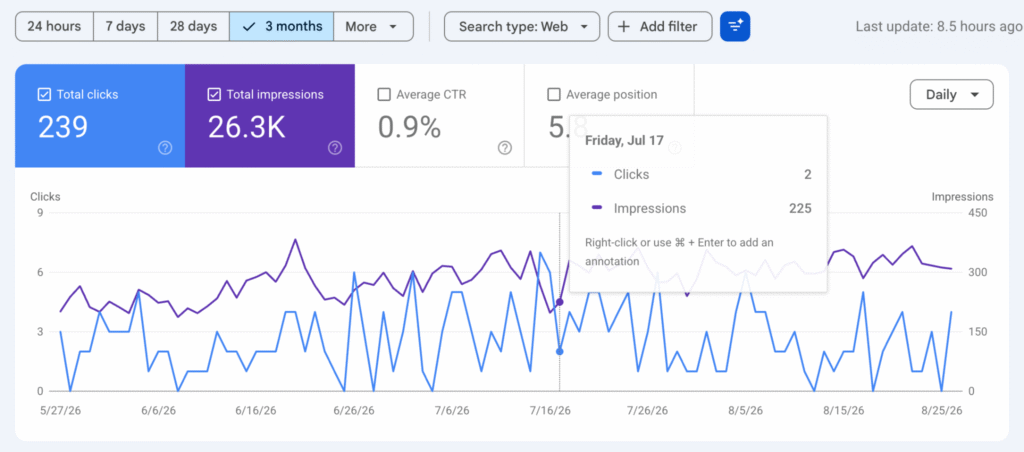
Google Search Console itself separates impressions, clicks, CTR and position because each tells you something different about performance. The platform’s current guidance also recommends focusing on trends in impressions and clicks rather than treating average position as the only measure of success.
What you can do: define the commercial outcome before diagnosing the channel. Connect Search Console and analytics data to forms, calls, purchases, demos or whatever produces value for the business. Then judge SEO according to whether the right search visibility is moving those outcomes.
2. You have not given the strategy enough time
SEO can absolutely be too slow. But sometimes the problem is simply unrealistic timing.
A new website with little authority cannot publish five articles and expect to overtake established competitors three weeks later. Technical changes can also take time to be crawled and reassessed, particularly across larger websites.
The same applies after migrations. Google says small-to-medium sites can take several weeks for most URLs to be processed after a site move, with larger websites taking longer.
This does not mean every agency should be allowed to hide behind “SEO takes time” indefinitely.
There should still be leading indicators.
Are important pages being indexed? Are impressions expanding? Are previously invisible pages beginning to appear? Is non-branded visibility improving? Are commercially relevant searches moving in the right direction?
If nothing meaningful changes for months, waiting longer is not a strategy.
What you can do: agree what should reasonably improve at 30, 60, 90 and 180 days. Separate early indicators such as indexation and impressions from later commercial outcomes such as qualified leads and revenue.
3. Google cannot properly crawl or index your important pages
You cannot rank a page Google cannot access or chooses not to index.
It sounds obvious, yet indexation is still one of the first things worth checking when SEO is not working.

A service page may accidentally contain a noindex directive. Canonicals may point elsewhere. Important URLs may sit outside the internal-link structure. A JavaScript implementation may make content difficult to process. Ecommerce filters may create thousands of low-value URLs while core product pages receive less attention.
Google does not promise to index every page it discovers.
Our guide to indexation and crawl-budget problems focuses on helping Google identify which URLs actually matter rather than trying to force every URL into the index.
What you can do: inspect important URLs individually in Search Console, review indexing reports, crawl the website and compare the pages you want indexed against the pages Google actually selects. Then fix the underlying discovery, canonical, quality or technical problem rather than repeatedly pressing “request indexing”.
4. You are targeting keywords but missing search intent
A keyword can be perfectly relevant to your business and still be wrong for the page you created.
Suppose a software company wants to rank for:
project management software
If Google predominantly returns commercial product pages and comparison platforms, publishing a 3,000-word article explaining what project management software means may not satisfy the dominant intent.
The keyword is not the problem.
The page type is.
The same issue occurs when businesses create service pages for highly informational searches or informational articles for queries where customers clearly want to buy, book or compare.
This is one of the most common SEO problems because keyword tools make phrases look like independent opportunities when Google’s results may group several of them around one underlying need.
What you can do: inspect the current SERP before deciding what to build. Look at the dominant page types, formats and intent, then decide whether the query deserves a service page, product category, comparison, guide, location page or something else.
5. Your content is technically fine but adds nothing new
A page can be well written and still have no compelling reason to rank.
This is becoming increasingly important as businesses produce more content with increasingly similar research.
Imagine ten websites all publish an article called “How to Improve Employee Retention”.
Every article says employees want better communication, career progression, competitive pay and recognition.
Which one deserves to rank first?
Length will not solve the problem.
Adding another five headings will not solve it either.
Google’s people-first content guidance consistently asks whether content provides original information, useful analysis, substantial value and first-hand expertise rather than merely summarising what other sources already say.
Every Content marketing approach focuses on real search demand and commercial usefulness rather than producing blog posts simply to increase volume.
What you can do: add something the search results do not already contain. Use internal data, first-hand examples, expert commentary, case studies, screenshots, methodology, calculations or a clearer specialist perspective. If your page could have been written without knowing anything about your industry, it probably needs more substance.
6. Your existing content has decayed
Sometimes the strategy worked perfectly well.
Then it stopped.
Older pages can lose traffic because the information becomes outdated, competitors improve, search intent shifts or a once-strong page gradually becomes less complete than the results around it.
That does not mean you need to abandon the URL.
Pages with historical rankings, backlinks and Search Console data can be some of the strongest opportunities on a website.
Remember, refreshing old content explains why improving proven URLs can often be more productive than creating another article from scratch.
What you can do: identify pages with meaningful historical performance that have declined while the underlying search demand remains relevant. Compare old and current Search Console data, review what now outranks the page and update it substantially. Changing the year in the title is not a content refresh.
7. Several of your pages are competing for the same intent
More content can create its own problem.
A website might have one page targeting “SEO agency Dubai”, another for “SEO company Dubai”, another for “Dubai SEO services” and another for “best SEO agency Dubai”.

If all four are commercial pages trying to sell essentially the same service, Google may receive several competing signals about which URL should represent that intent.
This is commonly described as keyword cannibalisation.
Not every overlapping keyword is a problem. Two pages can appear for the same phrase while serving different user needs perfectly well.
The issue becomes more serious when the wrong URL ranks, competing pages repeatedly swap positions or internal authority gets divided between near-duplicate pages.
What you can do: map important search intents to a preferred URL. Where two pages genuinely do the same job, consolidate them. Where they serve different needs, make the distinction much clearer through content, headings, titles and internal linking.
8. Your internal linking tells Google the wrong pages matter
A website’s structure communicates priority.
If your highest-value service page sits five clicks from the homepage and receives almost no contextual internal links, while an old blog post is linked from 70 pages, the site itself is reinforcing the wrong URL.
Internal links help search engines discover pages, understand relationships and identify which content sits at the centre of a topic.
They also help customers move naturally from research to action.
This is one reason a technical SEO review should examine architecture and internal links rather than treating technical SEO as a collection of page-speed scores.
What you can do: identify commercially important pages and review where internal authority currently flows. Add relevant contextual links from established content, improve navigation and hubs where appropriate, remove orphaned URLs and use anchor text that describes the destination naturally.
9. Your titles and search snippets are failing to earn clicks
Ranking is only useful when somebody chooses your result.
A page can receive thousands of impressions and still produce disappointing traffic because its title is vague, repetitive or poorly matched to the searcher’s need.
Search Console specifically recommends investigating pages with high impressions and weak CTR and considering whether titles, descriptions or the page itself better need to align with the queries triggering the result.
This becomes particularly important when several similar results compete on the same SERP.
“SEO Services | Company Name” gives the user very little reason to choose you.
A specific title communicating the service, location or useful distinction may do much more.
Our title tag and meta description guide goes deeper into auditing that gap.
What you can do: find pages with meaningful impressions but weaker-than-expected clicks, segment the queries creating those impressions and rewrite the snippet around what the searcher actually values. Do not add clickbait that the page cannot deliver.
10. Technical changes have damaged signals you already earned
SEO performance can decline even when nobody on the marketing team changed the strategy.
A redesign can change URLs. A CMS update can alter canonical tags. Developers can remove internal links.
A migration can redirect dozens of strong pages to the homepage instead of their closest replacements. A staging environment can accidentally become indexable.
These changes are particularly dangerous because the new website may look better while organic performance quietly deteriorates underneath it.
Google’s migration guidance recommends maintaining proper redirects for a long period, updating internal links and allowing time for new URLs to be recrawled and processed.
The fix: if performance changed after a redesign, migration, domain change or CMS rebuild, compare the old and new website. Review URL mappings, redirects, canonicals, internal links, metadata, indexability, structured data and tracking. Establish what changed before rewriting content that may never have been the problem.
11. Your website has weak authority in a competitive market
Sometimes nothing is obviously broken. You are simply competing against websites with stronger reputations and significantly more independent evidence of authority.
Links still matter because they help search engines discover and understand relationships between pages and websites. But authority should not be reduced to buying large numbers of backlinks.
A law firm referenced by recognised legal publications, professional bodies and credible industry sources has a very different external footprint from a new website with fifty links from unrelated directories.
What you can do: give credible websites a reason to reference you. Original research, useful tools, expert commentary, strong digital PR, industry partnerships and genuinely valuable resources usually create a healthier authority profile than purchasing links at scale.
12. You are ignoring local search behaviour
For businesses serving customers within a physical area, traditional organic rankings only show part of the picture.
A dentist, restaurant, estate agent, contractor or clinic may lose significant opportunities if the website performs reasonably well but the Google Business Profile is incomplete, reviews are weak or local information is inconsistent.
Google says local visibility is driven primarily by relevance, distance and prominence. You cannot control the searcher’s location, but you can influence how clearly Google understands the business and how established it appears.
For Dubai-based companies, Our posts about local SEO service addresses the relationship between Google Business Profile, websites, reviews, citations and wider local authority.
What you can do: if customers search locally, audit Maps and local-pack visibility separately from standard rankings. Review categories, business information, reviews, location pages, website relevance and local authority. Do not assume organic position five tells you how visible the company is in Maps.
13. Your traffic is growing but the website does not convert
This is where an SEO strategy not working can actually be a conversion problem.
Imagine organic traffic doubles but enquiries remain flat. SEO may have succeeded at generating visibility. The commercial journey failed afterwards.
Perhaps the landing page does not explain the offer clearly. Maybe there are no useful trust signals. The form asks for too much information. Pricing is confusing. The mobile layout buries the CTA. Or the traffic itself is informational and was never particularly likely to convert.
Conversion rate optimisation explains why traffic and conversion need to be evaluated together rather than treating acquisition as the end of the job.
What you can do: segment organic users by landing page and query intent, then measure what happens after the click. Review forms, calls, CTA engagement and actual lead quality. Do not commission another six months of traffic growth before understanding why the current visitors are not converting.
14. You reacted to an algorithm update instead of diagnosing it
Traffic falls. Google confirms an update. Everyone starts changing pages.
That sequence can do more damage than the update itself.
Core updates are broad reassessments of Google’s search systems. A loss does not automatically mean you have received a penalty or that one particular SEO tactic suddenly became invalid.
The affected pages may have weaker content than their new competitors. The intent may have changed. Trust may be insufficient. Technical weaknesses may have existed for years and only become more visible as competition improved.
Google’s current core-update guidance recommends analysing meaningful declines carefully and making changes that genuinely improve the site rather than searching for quick fixes.
What you can do: compare pre- and post-update performance in Search Console, identify exactly which page and query groups declined and review what replaced them. Separate content, technical, authority and intent problems instead of rewriting the entire website because one update happened near the same date.
15. You are doing lots of SEO work without prioritising impact
This is the problem that often sits underneath all the others. Teams can stay extremely busy while organic growth remains flat.
Someone is rewriting meta descriptions.
Someone else is publishing four articles every month.
Nobody has established which problem is currently limiting growth.
That is why an SEO audit should do more than produce a giant list of issues. Eclypseo’s current audit process reviews crawlability, indexation, technical foundations, architecture, keyword intent, content, UX and commercial measurement, then prioritises what is most likely to affect leads and revenue.
Not every SEO problem deserves equal attention.
A missing image alt attribute and an accidental noindex tag on the highest-revenue service page should not sit beside each other with the same priority.
What you can do: rank SEO actions according to likely commercial impact, confidence and effort. Fix the constraints first. Then measure what changed before moving to the next large initiative.
How to diagnose why your SEO isn’t working
Before changing anything, establish the shape of the problem.
Compare a meaningful period in Google Search Console rather than looking at yesterday versus today. Separate branded from non-branded searches where enough data is available. Review which pages gained or lost impressions, which queries changed and whether clicks fell because rankings declined or because search behaviour changed.
Our Search Console regex guide is useful here because a single headline traffic number often hides very different trends underneath it.
You may find informational traffic is falling while high-intent service visibility is improving.
That is a very different situation from losing every commercial keyword.
Then connect search performance to analytics and commercial data. If rankings and clicks increased but leads did not, investigate conversion. If impressions disappeared while indexed pages remained stable, investigate rankings, intent and competition.
If important URLs vanish from Search entirely, start with indexation and technical signals. Diagnosis should determine the work.
Not the other way around.
SEO should create progress you can explain
There is no single reason SEO isn’t working. That is why generic fixes usually disappoint. Publishing more articles does not solve an indexation problem.
Improving rankings does not solve a broken conversion journey. And waiting another six months will not rescue a strategy that has never prioritised the right opportunities.
Strong SEO creates a chain that makes commercial sense. Google can access the pages. The right pages target the right searches. The content deserves visibility.
The authorities support it.
If one part of that chain breaks, the answer is to find it rather than simply “do more SEO”.
If your organic traffic is not growing, rankings have stalled or you’re spending money on SEO without being able to explain what it is producing, contact Eclypseo for a review of the technical, content and commercial problems limiting performance.
The objective is to identify what is actually stopping organic search from producing stronger visibility, qualified leads and revenue.