
A page can contain the right keyword, be technically sound and still struggle to rank.
Often, the problem is not that Google cannot understand the topic. It is that the page does not match what the searcher is actually trying to do.
Someone searching “what is CRM software?” needs an explanation. Someone searching “best CRM for construction companies” is comparing options.
Someone searching “HubSpot pricing” is much closer to a commercial decision. Treating those queries as if they all deserve the same type of page creates weak content, poor conversions and a lot of wasted SEO effort.
That is where search intent becomes useful.
It helps you move beyond keywords and understand the task behind the search, the type of result Google currently considers useful, and the page you should build to compete.
What is search intent?
Search intent is the purpose behind a query. It describes what the person searching is trying to achieve rather than simply the words they typed.
Google does not publish one official four-part “search intent framework”. The familiar labels used by SEOs are a practical way of organising behaviour. Google itself describes ranking as a process of finding pages that are both high quality and relevant to the user’s query, with relevance also influenced by context such as location, language and device.
This is why keyword research should not stop at search volume.
Two phrases can look closely related in a keyword tool while producing completely different search results because the underlying need is different.
A useful SEO strategy therefore asks two questions: is there demand for this topic, and what kind of page does that demand actually require?
Why search intent matters more than keyword matching
Exact keyword matching is much less useful than it once was as a way to decide what a page should contain. Google is capable of understanding related wording, concepts and context, so a page does not need to repeat every variation of a phrase to become relevant.
Most content marketing process follow the same principle. Search demand matters, but content is mapped against intent and commercial opportunity so the page has a reason to exist beyond ranking for another variation of a keyword.
This is also why a page can rank for dozens of related searches without targeting each one individually. If the page solves the underlying need well, Google can connect it to several ways of expressing the same intent.
The four common search intent types
Most keyword-intent models group searches into four broad categories. They are useful starting points, but real search behaviour is often messier. A query can contain more than one intent, and the live search results should always take priority over the label you assign in a spreadsheet.
1. Informational intent
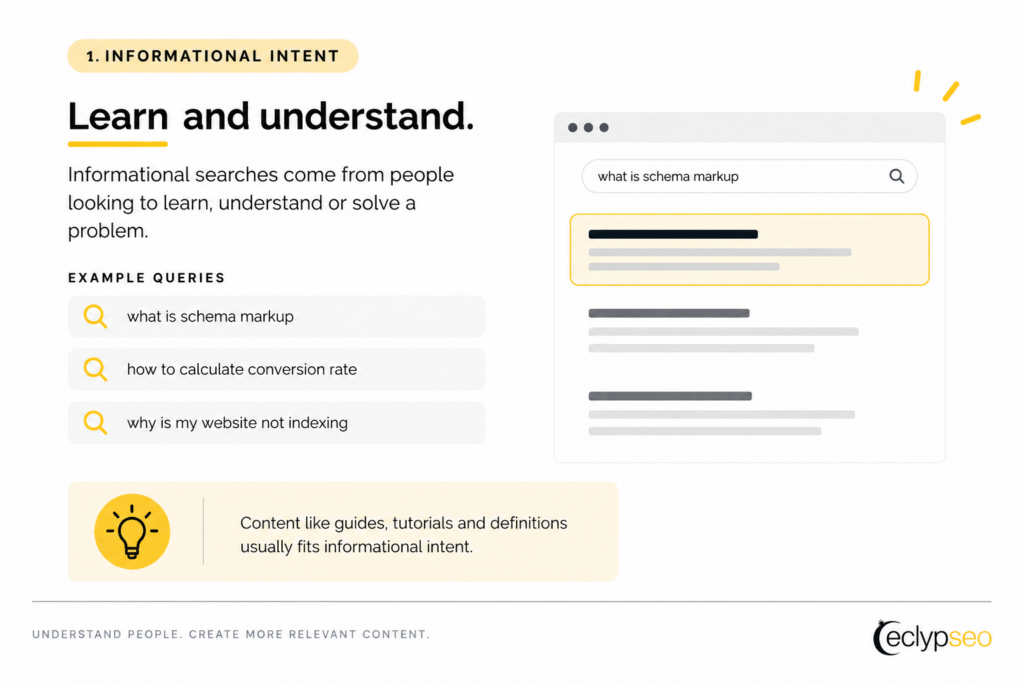
Informational searches come from people trying to learn, understand or solve something. Queries such as “what is schema markup”, “how to calculate conversion rate” or “why is my website not indexing” are primarily asking for information. Guides, tutorials, definitions, videos and explanatory articles often fit this intent. The commercial opportunity can still be valuable, particularly when the problem naturally leads towards a service, but forcing a sales page into an informational search usually creates a mismatch.
2. Navigational intent
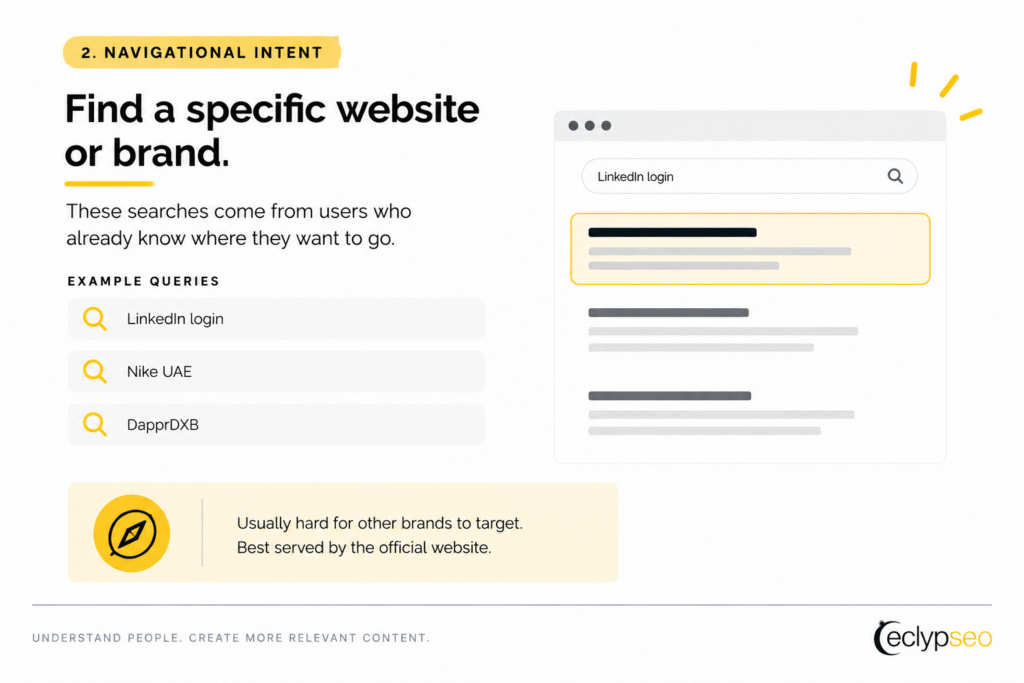
Navigational intent appears when the user already knows the website, company or destination they want. “LinkedIn login”, “Nike UAE” or a branded search for a company contact page are straightforward examples. These searches are normally difficult and unnecessary for another brand to target. If someone is clearly trying to reach a specific business, creating an article around that brand name is unlikely to satisfy the intent better than the destination they already wanted.
3. Commercial investigation intent
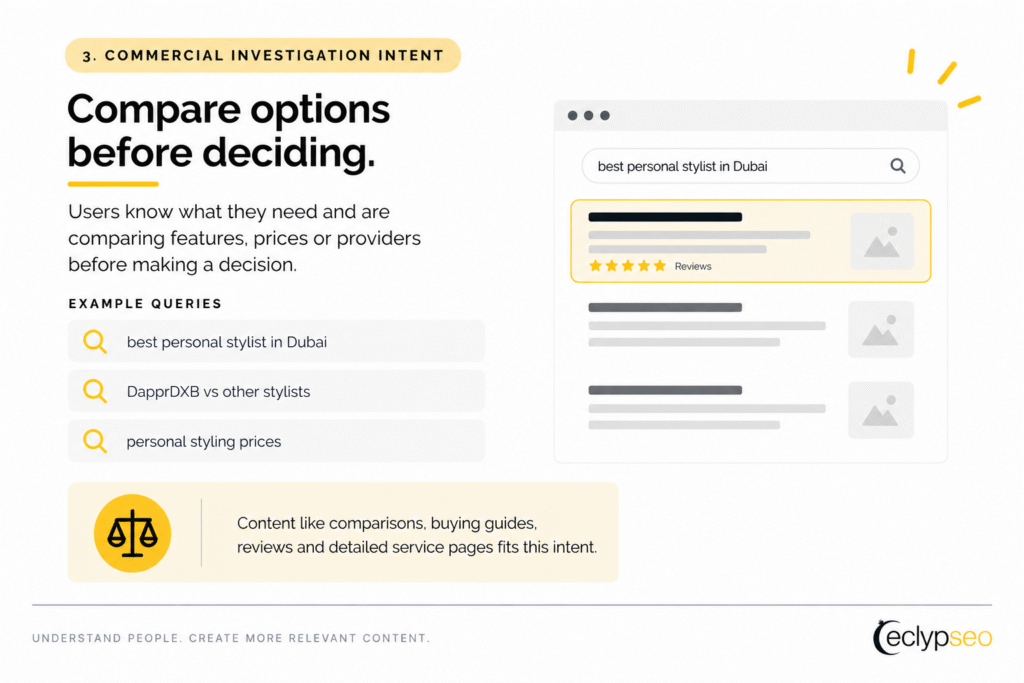
Commercial investigation sits between research and purchase. The user knows roughly what they need but is comparing options, costs, features or providers before making a decision. Queries containing “best”, “vs”, “reviews”, “alternatives”, “pricing” or “for small business” often fall into this category. Comparison pages, buying guides, detailed service explanations and product roundups can work well when they genuinely help someone evaluate choices.
This stage is commercially important because the user may be only one or two decisions away from becoming a customer. Generic top-of-funnel education can therefore feel frustrating if the person already understands the basics and wants help choosing.
4. Transactional intent
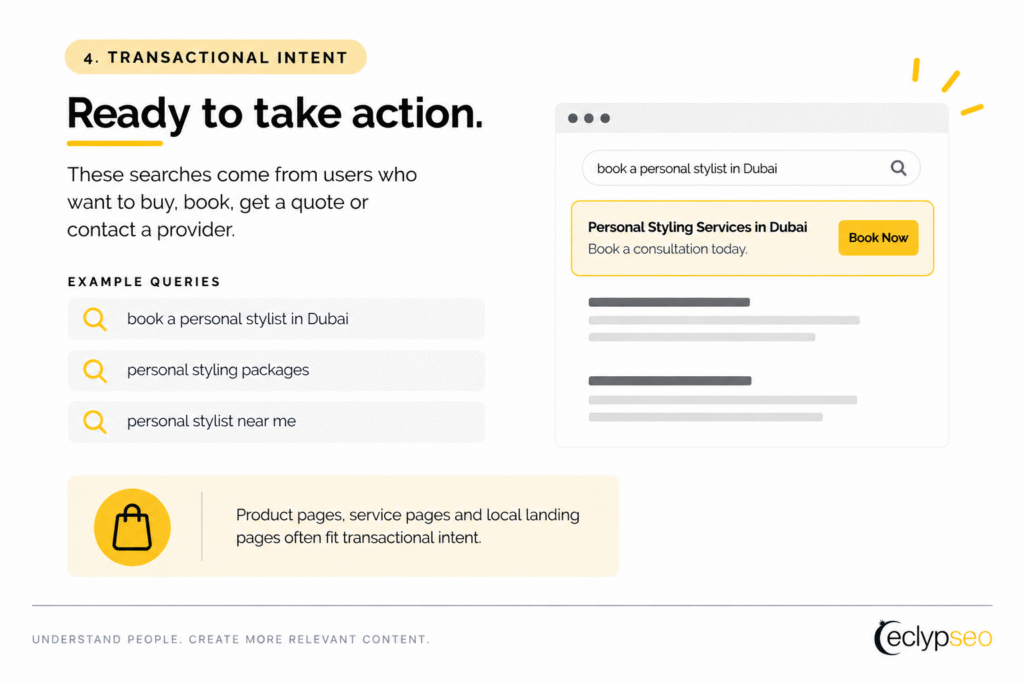
Transactional searches suggest the user is ready to act. That action might be buying a product, booking a consultation, requesting a quote, downloading software or finding a local provider.
Product pages, service pages, category pages and local landing pages commonly fit this intent. A search such as “personal trainer Dubai Marina” needs a very different result from “how does personal training work”, even though both relate to the same subject.
How to identify search intent step by step
The fastest way to get intent wrong is to assign it from the keyword alone. Modifiers are useful clues, but Google’s current results show you what its systems are actually choosing to serve for that query.
Step 1: Read the keyword modifiers, but do not stop there
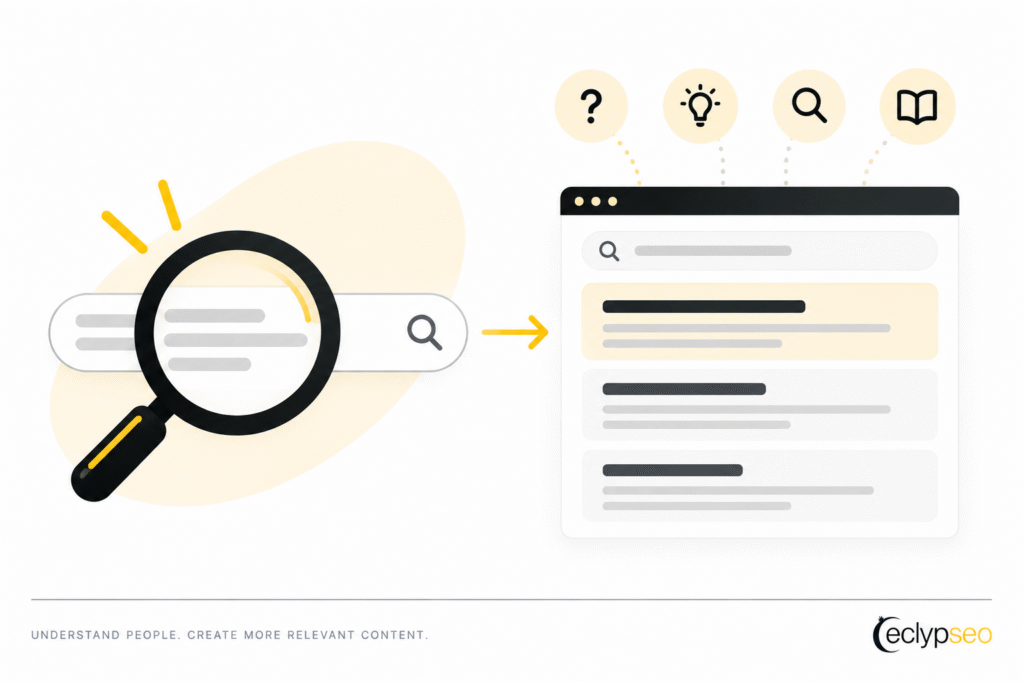
Start with the wording. “How”, “what”, “why” and “guide” often point towards informational intent.
“Best”, “review”, “compare” and “vs” commonly suggest commercial investigation, while “buy”, “book”, “near me”, “price” or a specific product name can indicate stronger transactional intent.
These are clues rather than rules. “SEO pricing” could produce agency pricing pages, guides explaining typical retainers, calculators or comparison content depending on the market. The keyword gives you a hypothesis. The SERP tests it.
Step 2: Search the query and inspect the dominant page type
Search the term in the market you actually want to compete in and look at the types of pages occupying the strongest positions.
If Google mainly returns ecommerce categories, publishing another blog post is unlikely to be the best response. If the results are dominated by detailed guides, a thin service page may struggle even if the business sells something related to the topic.
Pay particular attention to repeated patterns. One unusual result does not define the intent. If eight of the top ten results are category pages, that is a much stronger signal about what Google believes most users want.
Step 3: Look at the format and angle Google keeps rewarding
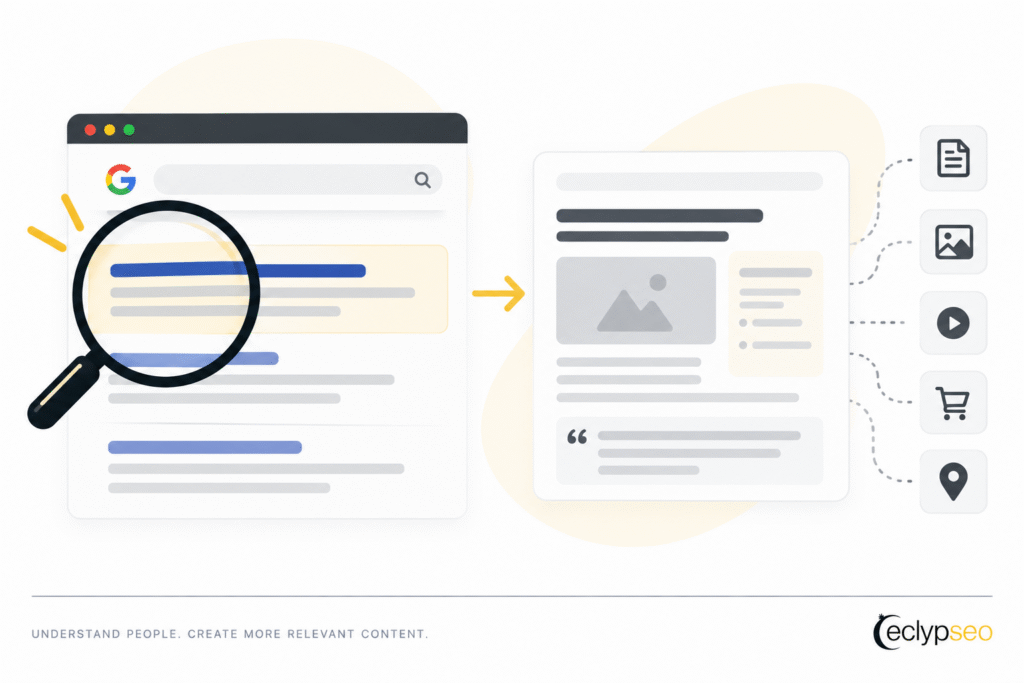
Page type tells you whether the result is a guide, service page, category or product. Format and angle tell you what the page needs to do inside that type.
For “best project management software”, the strongest results may be comparison lists rather than generic software pages.
For “how to fix a leaking tap”, step-by-step instructions may dominate.
For a query containing “2026”, freshness may be part of the expectation because the user is explicitly looking for current information.
Titles are useful evidence too. Our guide to title tags and meta descriptions makes the same point: a title should signal that the result matches the primary query and the reason someone searched, not simply contain the target phrase.
Step 4: Read the SERP features for additional intent clues
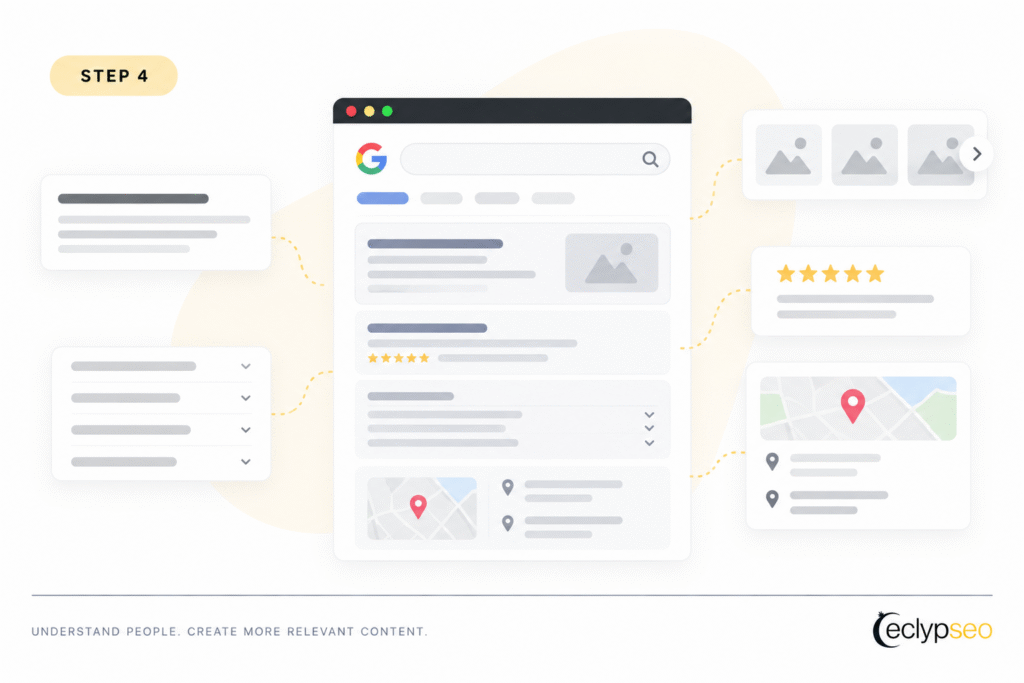
The rest of the search result can tell you as much as the ten organic links. A local pack suggests location and proximity matter. Shopping results indicate product intent. Videos can show that a process is easier to understand visually. People Also Ask questions can reveal the follow-up information users need before completing their task.
Google’s own documentation explains that the features shown on a results page vary with the query.
A search for a local repair shop is likely to trigger local results, while a visually oriented search may surface images instead. The SERP itself is therefore part of your search intent analysis.
Step 5: Validate the intent against your Search Console data
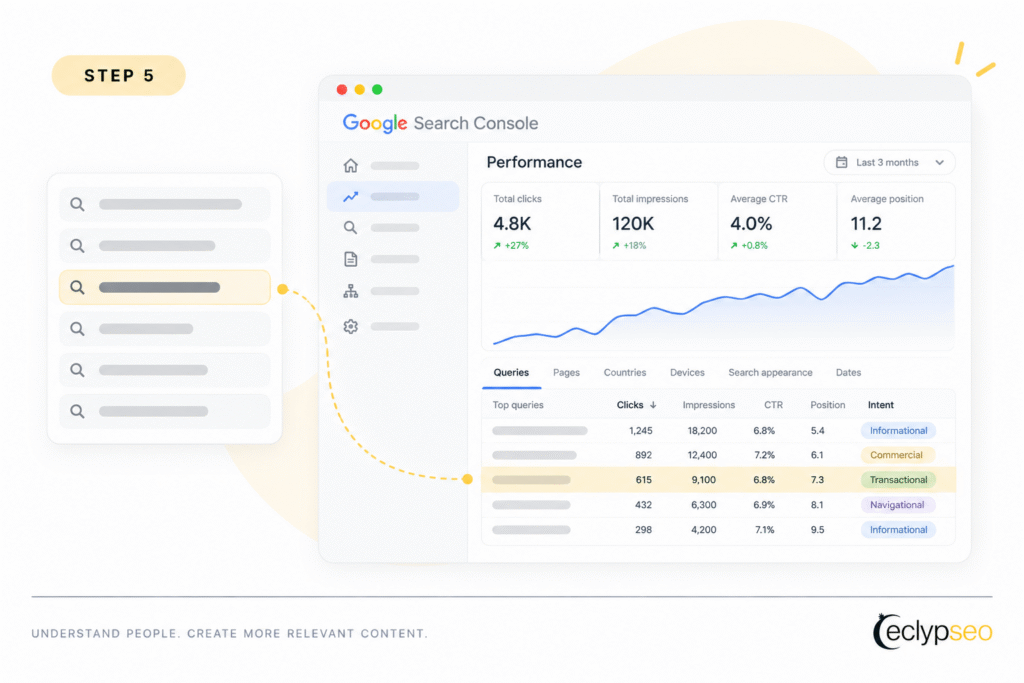
The live SERP shows what Google is rewarding generally. Search Console shows how Google is already interpreting your own pages. Open the queries for an important URL and look at the patterns creating impressions.
You may discover that a service page is appearing mainly for informational questions, or that an article intended for early-stage research is receiving impressions for commercial searches it does not answer well.
For larger datasets, Google Search Console regex guide can help separate question-led, comparison, location and problem-solving searches so intent patterns are easier to see.
This is particularly useful when a page has impressions but weak clicks. The issue may not be “bad metadata”. The underlying page may simply be appearing for searches it was never designed to satisfy.
Step 6: Map one primary intent to each important page
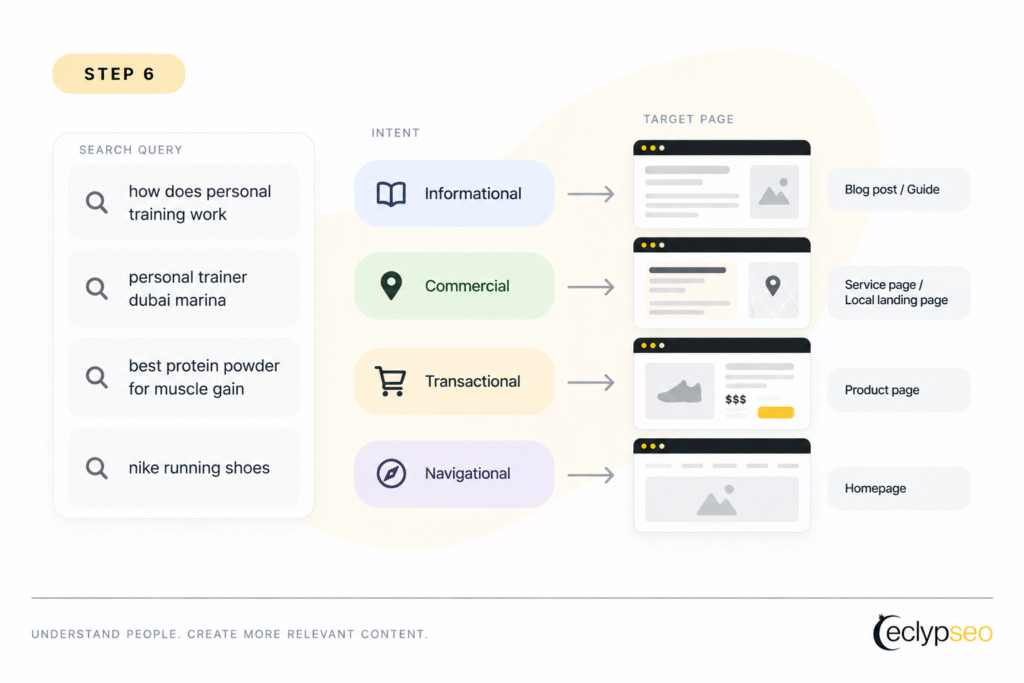
Once the intent is clear, decide which URL should own it.
A website does not need a new page for every keyword variation. “SEO agency Dubai”, “SEO company Dubai” and “SEO services Dubai” may represent one commercial need rather than three separate landing pages.
Creating several URLs for the same underlying intent can split internal links, create keyword cannibalisation and leave Google choosing between pages that do essentially the same job.
A proper SEO audit should therefore include keyword and intent mapping alongside technical checks. The objective is to know which page should rank for which search requirement and where the site is duplicating or missing demand.
Step 7: Build the page for the stage of the decision
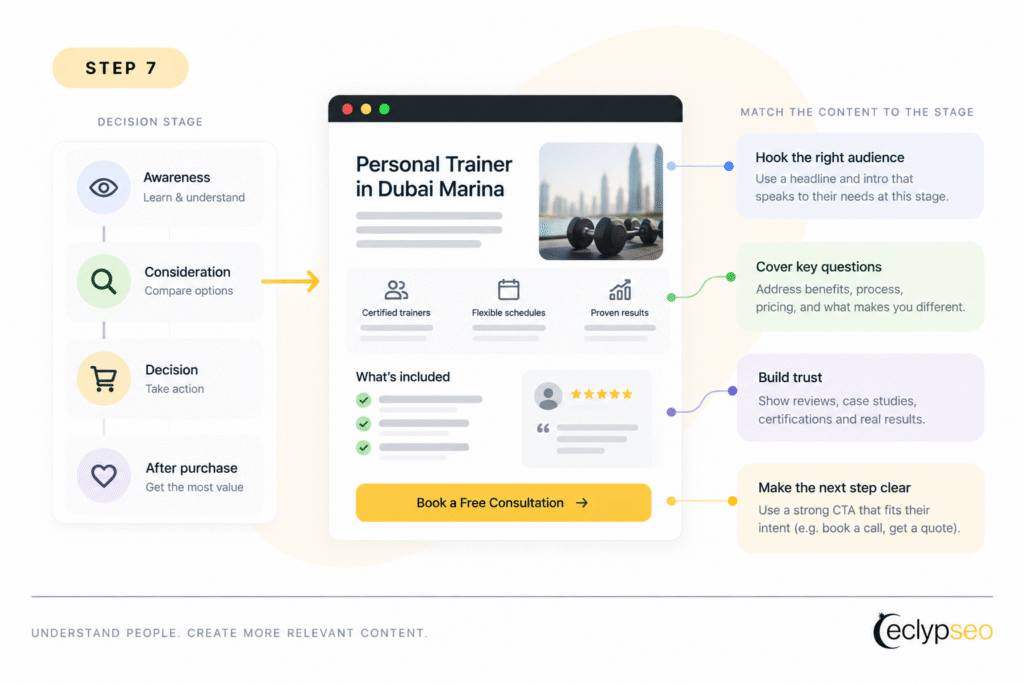
Matching intent is not only about choosing the right page template. The depth and emphasis of the content should reflect how much the user already knows.
A beginner searching “what is CRM” needs definitions, examples and basic context. Someone searching “HubSpot vs Salesforce for a 20-person sales team” does not need 600 words explaining what a CRM is before the comparison begins.
They need differences, costs, limitations, implementation considerations and evidence that helps them decide.
Our guide to common ChatGPT content mistakes shows how content often mixes informational and commercial intent, resulting in pages that technically cover the topic but frustrate the person searching.
What happens when your content does not match intent?
Intent mismatch can look like several different SEO problems.
The page may struggle to rank at all because Google consistently prefers another page type. It may receive impressions without many clicks because the title promises something different from the results users actually want.
Or it may attract traffic and still fail commercially because visitors arrive at an educational page when they are ready to buy.
The fix is not always to rewrite the existing page. Sometimes the right answer is to create a new page for the missing intent, consolidate competing URLs or deliberately keep an informational page separate from a commercial one.
The decision should follow the search behaviour, not the convenience of the existing site structure.
Search intent can change over time
Search intent is not permanent.
Markets change, products mature and Google tests different result types. A query that once produced mostly educational articles may become more commercial as buyers become familiar with the category.
Seasonal events, new regulation and major product launches can also shift what users need from a result.
That means a page that matched intent two years ago can gradually fall behind without becoming factually wrong. The result format around it changed.
Recheck the live SERP when an important page declines. If the dominant result type has changed, adding another 1,000 words to the existing format may not solve anything.
What does search intent mean for AI Overviews and AI Mode?
AI-generated search makes intent broader rather than less important.
Google says AI Overviews and AI Mode can use techniques such as query fan-out, where the system searches across related subtopics before producing an answer.
That means one complex request can contain several smaller intents: definition, comparison, evidence, product information and next steps.
This does not mean you should create a separate page for every possible fan-out query.
Google’s 2026 generative-search guidance explicitly warns against producing large numbers of pages for minor query variations simply to manipulate rankings or AI responses.
The better approach is to understand the wider decision. A strong page should answer the parts of that decision it is genuinely qualified to cover, provide distinctive evidence and make the next step clear.
In other words, AI search does not remove the need to match content to search intent. It makes shallow keyword matching even less useful.
Strong content but weak rankings? Check the intent before creating more
When a page is technically healthy and well written but still underperforms, do not automatically assume it needs more backlinks, more words or another round of optimisation.
Search the query again. Look at what Google is actually rewarding. Compare the page type, format, angle and stage of the customer journey against the results that consistently outrank you.
If your website is attracting the wrong traffic, ranking the wrong pages or producing content without enough commercial impact, book an SEO consultation and we can identify where the mismatch is happening before you invest in more content.