
E-E-A-T is one of the most misunderstood ideas in SEO.
Some businesses treat it like a checklist. Add an author biography. Link to a LinkedIn profile. Put a few trust badges in the footer. Mention “years of experience” on the About page. Add Article schema. Then wait for rankings to improve.
That is not how E-E-A-T works.
E-E-A-T is not something you install. It is the combined evidence that helps people and search systems decide whether your content, its creator and the organisation behind it deserve to be trusted.
That evidence can come from the page itself, the wider website and independent sources across the web. It might include original research, first-hand experience, verifiable credentials, accurate citations, customer reviews, media recognition, clear policies or simply a reliable user experience.
This is why E-E-A-T SEO is not only a content-writing exercise. It touches brand reputation, technical SEO, digital PR, customer experience, editorial standards and the way a company proves its claims.
What is E-E-A-T?
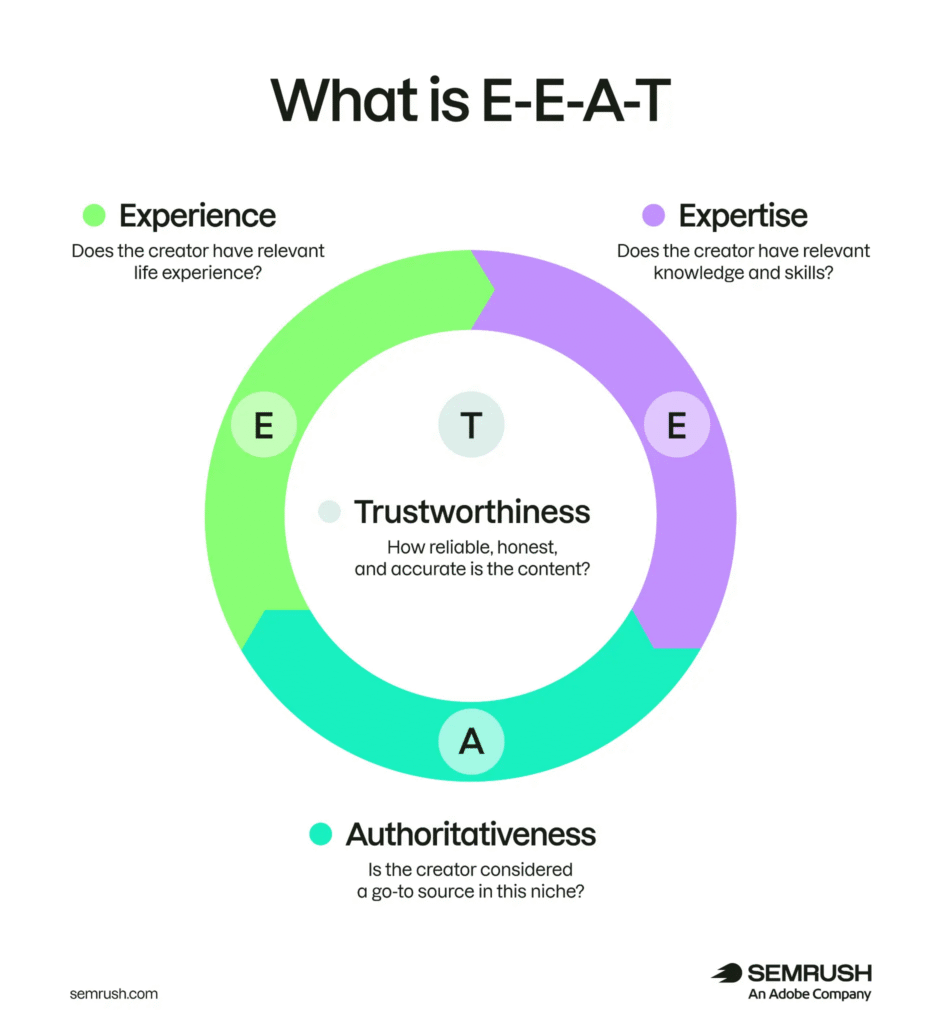
Image Source: Semrush
For anyone asking what is E-E-A-T, it stands for:
- Experience
- Expertise
- Authoritativeness
- Trustworthiness
Google formally added the extra “E” for Experience to its quality rater guidelines in December 2022. The change recognised that first-hand involvement can matter when evaluating whether content is genuinely useful.
Someone who has used a product, completed a process or lived through an experience may be able to offer insights that a purely theoretical summary cannot.
The framework appears in Google’s Search Quality Rater Guidelines. These guidelines help human evaluators assess whether search results satisfy users and demonstrate an appropriate level of quality.
Those ratings do not directly change the position of an individual webpage. Instead, Google uses the feedback to evaluate whether its search systems are producing useful results. The most important point in the guidelines is often overlooked:
Trust sits at the centre of E-E-A-T.
A creator may appear experienced, knowledgeable and well known, but the page still has weak E-E-A-T if it is misleading, unsafe, commercially deceptive or factually unreliable. Google’s guidelines explicitly describe trust as the central and most important member of the framework.
Is E-E-A-T a ranking factor?
There is no single E-E-A-T ranking factor, public E-E-A-T score or report inside Google Search Console.
Google does not provide a metric telling you that a website has “72 out of 100” for expertise, or that adding an author biography earned five extra points of trust.
Its systems use many signals to identify content that appears helpful and reliable. Some of those signals may align with the qualities described by E-E-A-T, but there is no single switch an SEO team can optimise.
This distinction matters because businesses often focus on visible decorations rather than underlying credibility.
Adding medical credentials to a biography, for example, is useful only when those credentials are genuine, relevant to the subject and connected to someone who genuinely contributed to or reviewed the page.
The medical information itself also needs to be accurate and current, while the wider website needs to behave like a trustworthy healthcare source.
A biography cannot rescue unsupported medical advice. Schema cannot turn an inexperienced writer into an expert. A review badge cannot compensate for fabricated testimonials.
The better question is not, “How do we increase our E-E-A-T score?”
It is: What evidence would a cautious customer need before acting on this information or choosing this business?
That question produces better SEO because it also produces a better website.
The Four Parts of E-E-A-T in Practice
1. Experience: Have you actually done this?
Experience refers to first-hand or direct involvement with the subject.
The strongest evidence usually comes from material that could only exist because someone genuinely did the work.
Original photographs, screenshots from a real process, test results, product usage notes, project timelines and before-and-after comparisons can all make experience visible. So can honest descriptions of mistakes, lessons, personal observations and data collected during delivery.
Consider two articles reviewing the same software.
The first summarises the features listed on the company’s product page.
The second shows screenshots from three months of use, explains where the software worked, identifies where it failed and provides examples from a real workflow.
Both may be accurate.
Only one strongly demonstrates first-hand experience.
Experience is also contextual. Someone who has recovered from a medical procedure may be a valuable source for describing what that recovery felt like. That does not necessarily qualify them to prescribe treatment or contradict established medical advice.
Google’s current guidelines distinguish between valuable personal experience and advice that should come from appropriately qualified experts, particularly on Your Money or Your Life topics.
2. Expertise: Do you understand the subject?
Expertise is the knowledge or skill required to discuss a topic accurately.
Formal qualifications matter when the consequences of poor advice are serious. Medical, legal, financial and safety content generally demands a higher standard than a recipe, travel story or product comparison.
But expertise is not limited to certificates.
A developer may demonstrate expertise through working software, detailed technical explanations and years of practical delivery. A chef may demonstrate it through original recipes, professional experience and the ability to explain why a particular technique works.
Strong author expertise tends to become visible through a combination of relevant qualifications, professional experience, original analysis, demonstrated technical skill and accurate use of evidence. Recognition from credible organisations and a history of useful work in the field can strengthen that picture further.
The goal is to match the right creator or reviewer to the right topic.
3. Authoritativeness: Are you recognised as a useful source?
Authority exists when other people or organisations recognise a person, page or business as a useful source for a subject. A company can claim expertise on its own website. Authority becomes stronger when independent evidence supports that claim.
That evidence might come through relevant editorial mentions, citations from industry publications, natural backlinks, conference appearances, interviews, professional memberships or customer recommendations.
Awards can help when their selection criteria are credible. References in academic or government resources can carry particular weight, as can consistent brand information across reputable platforms.
Authority is topic-specific.
A popular entrepreneur is not automatically authoritative on medicine. A national newspaper may be authoritative for investigative reporting but not the primary source for a company’s current opening hours. The company’s official website may be the most authoritative source for information about its own services, products and policies.
Google’s guidelines repeatedly ask evaluators to consider whether a source is recognised as a “go-to” source for the particular topic and purpose of the page.
4. Trustworthiness: Can users safely rely on you?
Trust is where all the other elements meet.
A trustworthy page should be accurate, honest, safe and reliable. The type of proof required changes according to the page.
For an ecommerce business, trust might be demonstrated through secure payment, clear returns information, genuine product reviews, accessible customer-service details and accurate stock and delivery information.
A healthcare article has different requirements. Users may need to know who wrote or reviewed the information, what medical evidence supports it, when it was last reviewed and where its limitations lie.
For a service business, trust can come from something as basic as a real address or clearly defined service area, working contact details and identifiable team members. Specific case studies, genuine reviews and transparent commercial claims then strengthen that foundation.
These are not decorative extras.
They are website trust signals that reduce uncertainty at the point where a user is deciding whether to believe, enquire or buy.
Why E-E-A-T has become more commercially important
Search results no longer consist only of ten blue links.
Potential customers may encounter a brand through Google AI Overviews, AI Mode, ChatGPT, Gemini, Perplexity, Reddit discussions, YouTube results, review platforms, Google Business Profiles or traditional organic listings.
This means a company may be assessed before the user ever visits its website.
A 2025 Pew Research Center study analysed 68,879 Google searches from 900 US adults. Users clicked a traditional result in 8% of visits where an AI summary appeared, compared with 15% when no summary appeared. They clicked a source inside the AI summary in only 1% of visits.
That study does not prove that E-E-A-T directly causes AI citations. It demonstrates a wider commercial problem: fewer users may reach the website during early-stage research. When clicks become harder to win, being merely visible is not enough. A brand needs to appear credible wherever the customer encounters it.
This is why our work around AI optimisation does not rely on one technical hack. It considers how clearly a brand is described, whether claims are supported, where it is mentioned and whether its content is worth citing.
How to build E-E-A-T without faking it
1. Start with the risk and purpose of the page
Before writing, define what the page is asking the user to believe or do.
Someone learning a low-risk skill does not need the same level of evidence as someone choosing a healthcare provider, making a financial decision or comparing an expensive purchase.
The same applies when users are booking services, following technical instructions or being asked to trust a performance claim. The greater the potential consequence of bad information, the stronger the required evidence should be.
A simple content-risk classification can help:
Risk level | Example | Recommended controls |
Low | Lifestyle inspiration | Experienced writer and basic fact-check |
Medium | Product or service comparison | Testing evidence, methodology and disclosure |
High | Health, legal or financial advice | Qualified expert, primary sources and formal review |
Commercial | Case study or sales claim | Verifiable figures, timeframe and clear attribution |
A blog about office décor does not need the same editorial controls as an article about pension investments. A personal account can be valuable for describing an experience, but professional advice should come from an appropriately qualified source.
This approach stops teams from applying the same shallow template to every page.
2. Build an evidence inventory before writing
Most weak content begins with a keyword and an empty document.
A better process starts with evidence.
Before drafting, look at what the organisation can genuinely contribute. Internal data, customer questions, expert interviews, screenshots and case-study results can all provide material. So can process documentation, original images, primary research, customer objections, examples of failed approaches and honest limitations of the product or service.
Then decide what the article can say based on that evidence.
This reverses the usual process. Instead of writing a confident claim and searching for something to support it afterwards, the writer builds the article around material the company can genuinely prove.
For example, do not begin with:
Our approach delivers significantly better SEO performance.
Begin with the evidence:
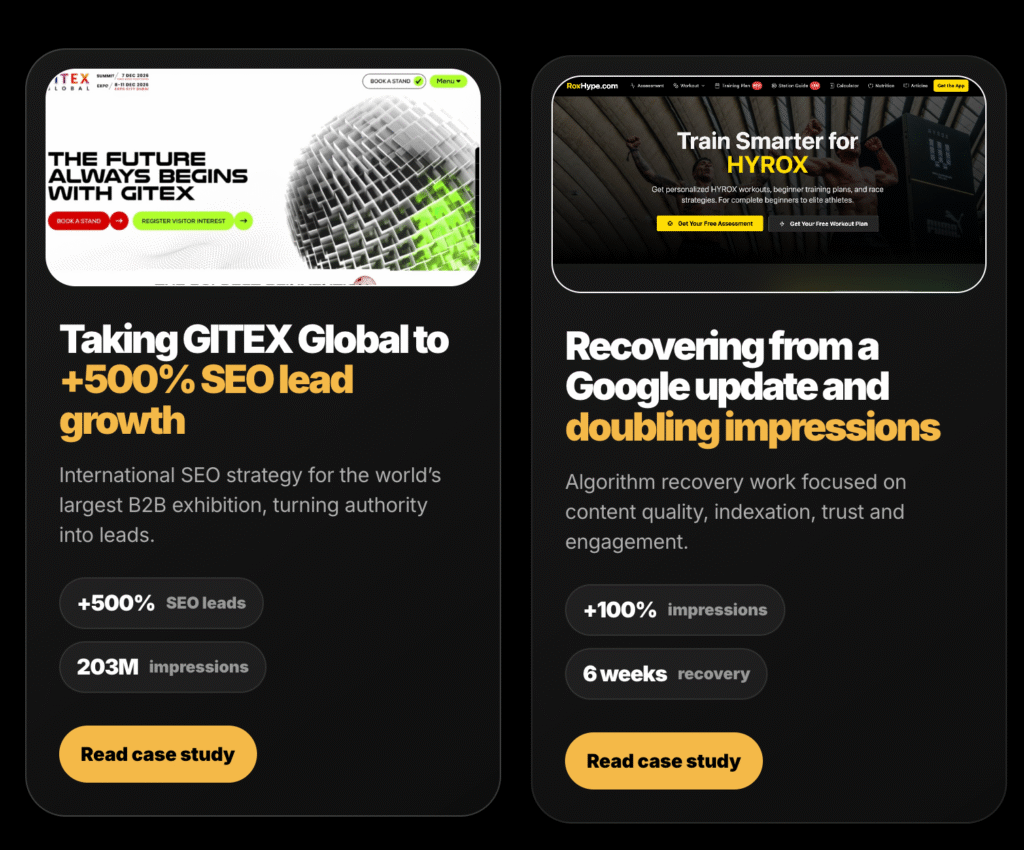
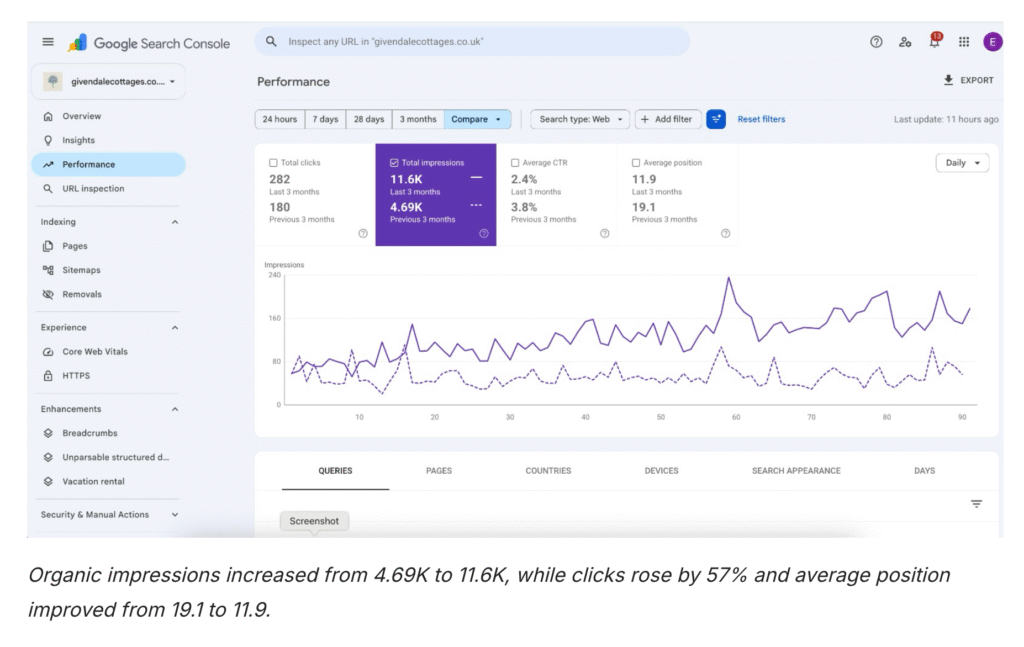
Daily organic impressions increased by 100% within six weeks after indexation, internal-linking, content and trust issues were addressed.
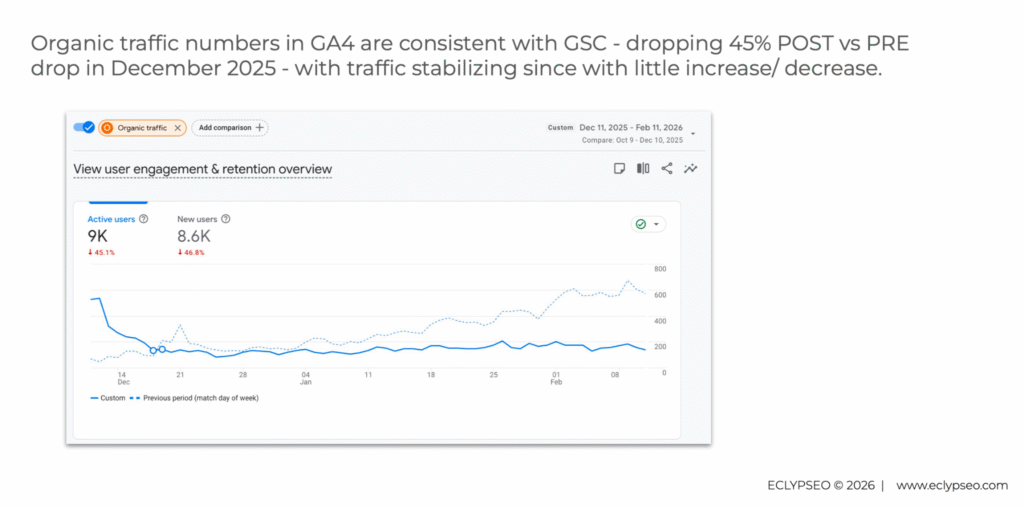
Then explain the baseline, timeframe, methodology, context and limitations. An SEO recovery case study follows this model by explaining the original decline, the diagnosis, the work completed and the measured outcome.
The published case study reports a 100% increase in daily impressions and a 25% improvement in engagement and dwell time over six weeks, while making clear that no single change caused the recovery.
3. Turn first-hand knowledge into visible proof
A company may have decades of experience and still publish generic content. The problem is not necessarily a lack of expertise. Often, the expertise is simply trapped inside the organisation.
Recorded interviews with specialists can uncover insights that never appear in a standard content brief. Post-project debriefs can reveal what actually went wrong and how it was fixed. Customer-support logs and sales-call objections can expose the questions customers repeatedly ask.
The same applies to screenshots from tools, internal checklists, testing notes, failed experiments, delivery templates and process walkthroughs. These materials turn internal knowledge into visible evidence.
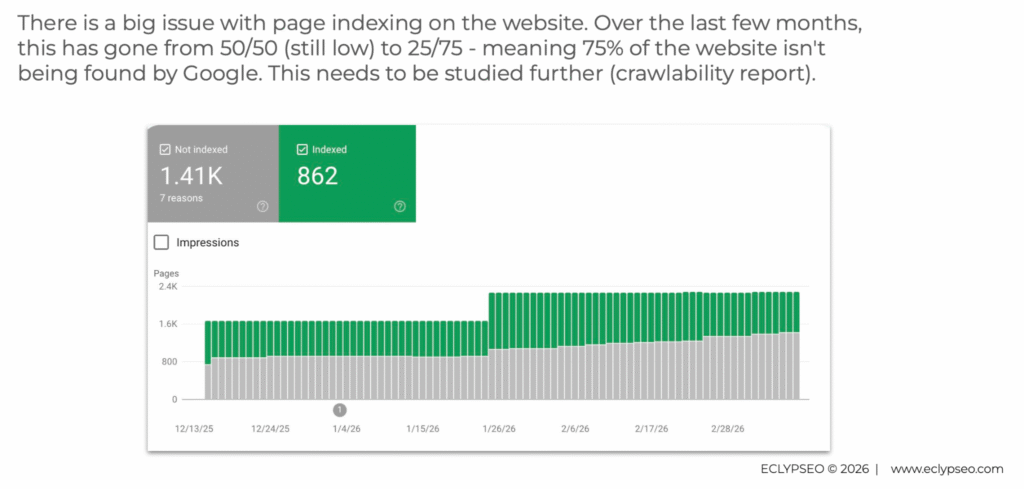
A technical SEO article, for example, becomes more credible when it includes an anonymised crawl example and explains how the issue was diagnosed.
A product review becomes stronger when the reader knows who tested the product, how long it was tested, what alternatives were compared and what criteria were used. Disclosing whether the product was supplied free and explaining the limitations found during testing makes that experience even easier to trust.
This is the difference between saying “we have experience” and demonstrating it.
4. Make authorship verifiable
Every important article should make it easy to understand who wrote it, why that person is qualified, whether anyone reviewed it and when the information was last checked.
An effective author profile should contain relevant information rather than a generic life story. It should also be clear what the person actually contributed.
For sensitive content, use a genuine reviewer rather than borrowing a credible name. That reviewer should see and approve the final claims, not simply agree to have their name attached to the topic.
Google’s quality guidelines state that clarity about who owns a website and who created its main content is particularly important for pages requiring high trust.
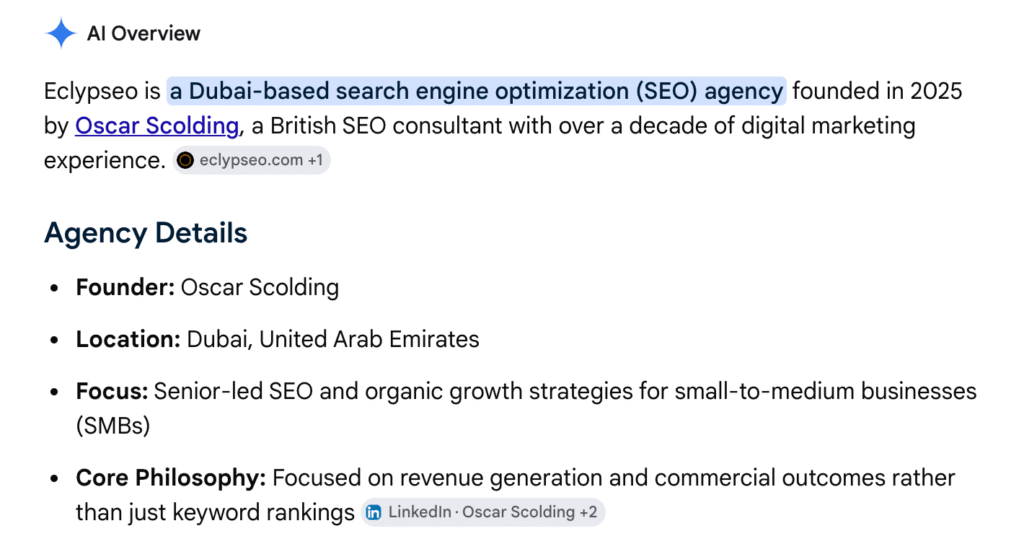
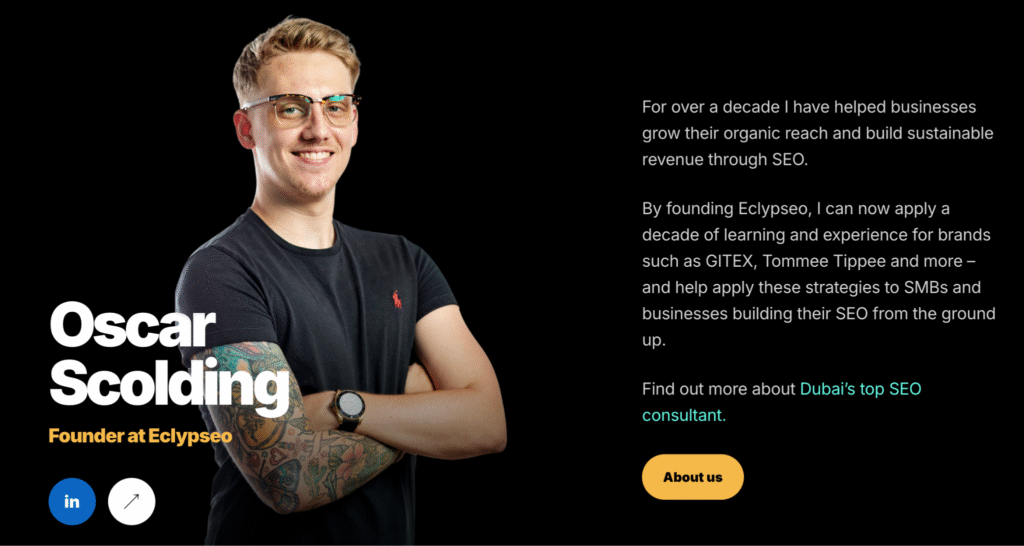
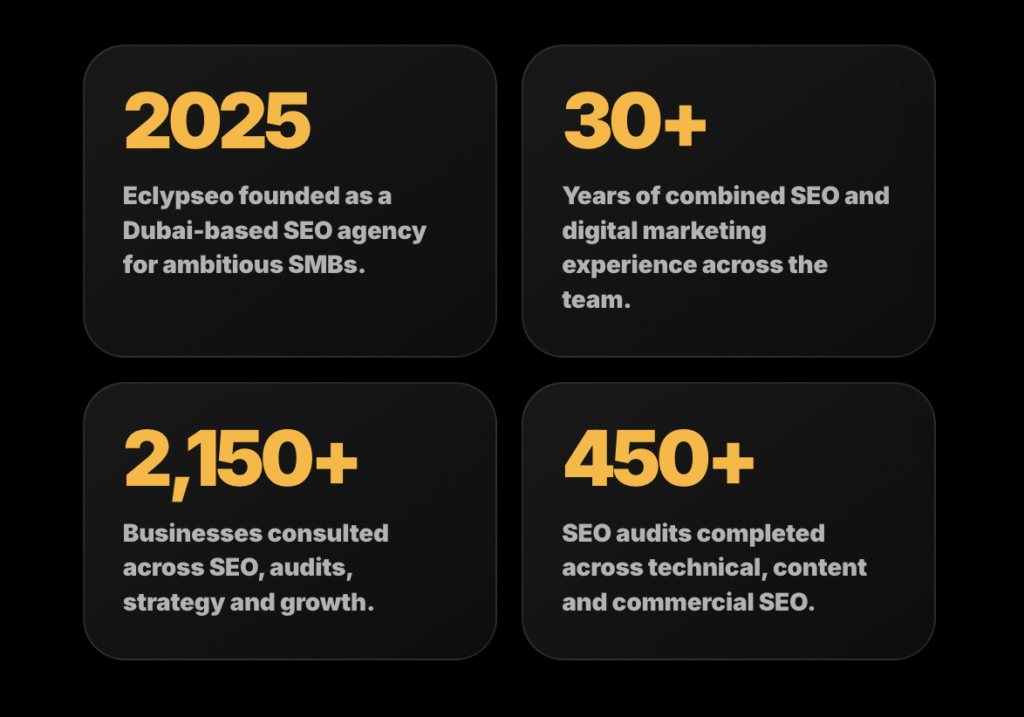
In general, a strong About page can reinforce this by explaining who runs the business, the team’s experience, how it operates and what makes it different. Eclypseo, for example, identifies its founder-led model, Dubai base and senior team rather than presenting itself as an anonymous agency.
5. Use an evidence hierarchy
Not every source carries the same weight.
For important claims, original company data, government publications, peer-reviewed research and official documentation should normally sit above secondary summaries or unverified opinions.
Reputable industry research can also be valuable when the methodology is visible. Credible editorial reporting may provide useful context, particularly when primary material is unavailable.
The principle is simple: link to the original source wherever possible. Good evidence-based writing should also explain what the data does not prove.
The Pew click study, for example, observed user behaviour around Google AI summaries. It does not prove that every website will lose a particular percentage of traffic. Strong content protects the limits of its evidence rather than stretching a statistic until it becomes a sales claim.
6. Build independent reputation
A website cannot fully validate itself.
For businesses asking how to improve website authority, the answer extends beyond publishing more blogs.
Independent evidence can come from useful original research, digital PR, expert contributions, partnerships, journalist commentary, podcasts and industry events. Relevant directories, professional associations, customer reviews and genuine community participation can all contribute too.
The goal is not to collect mentions for the sake of volume.
Buying irrelevant coverage or distributing the same press release across dozens of low-quality websites may create links, but it does little to establish meaningful authority.
A useful third-party mention should help confirm who the company is, what it specialises in, where it operates, who its experts are and what it has achieved. Ideally, it should also make clear why another credible source considered that company relevant enough to mention.
Our guide to appearing in AI search engines uses an impact, confidence and ease framework to prioritise actions across content, technical implementation and external authority rather than treating every tactic as equally valuable.
7. Make commercial claims specific
Vague claims weaken trust.
Compare:
We achieve outstanding results for leading brands.
With:
Organic traffic had fallen by more than 40%. After diagnosing indexation, content-quality and internal-linking problems, daily impressions increased by 100% within six weeks.
Insert image here
A credible case study should give the reader enough context to understand what actually happened. Explain the original problem, the metric and baseline used, the period measured and the work completed.
External factors and important limitations should be disclosed rather than hidden. Where possible, connect the result to a meaningful commercial outcome as well.
Percentage growth without context can be particularly misleading.
Increasing from one lead to three is technically a 200% increase, but that figure alone may create a much stronger impression than the underlying numbers justify.
Trust improves when a company is precise enough to risk being checked.
8. Strengthen technical and operational trust
Excellent writing on an unreliable website still creates a poor experience.
Important technical and operational checks include:
- HTTPS across the site
- Secure forms
- Functional contact routes
- Mobile usability
- Clear navigation
- Valid structured data
- Crawlable content
Google confirms that Core Web Vitals form part of its ranking systems, although good scores do not guarantee top rankings. Its wider page-experience guidance also encourages secure, mobile-friendly and accessible experiences because they make websites more satisfying to use.
Good technical SEO ensures that the pages containing your strongest evidence can be crawled, indexed and understood. It also prevents conflicting URLs, broken structures and indexation problems from weakening the wider site. Structured data can clarify who wrote an article or which organisation owns the website. It cannot prove that either deserves trust.
9. Create a content-governance process
Trust can decay.
A page that was accurate two years ago may now contain outdated regulations, statistics, product details or advice. Changing the publication date without reviewing the substance does not make the content current.
Review frequency should reflect risk.
High-risk YMYL pages may need to be checked every three to six months. Product, pricing or regulatory content should be reviewed whenever material changes occur. Commercial service pages may need a review every six to twelve months, while stable educational content can often be checked annually or when performance begins to decline.
The review itself should be substantive.
Ask whether the claims are still correct and whether the supporting sources remain active and current. Check whether the author’s role has changed, whether search intent has shifted and whether newer competing resources now provide something more useful.
Examples, calls to action and commercial offers should also be checked rather than automatically carried forward.
A visible “last reviewed” date should mean that someone genuinely reviewed the page.
10. Use AI to support expertise, not imitate it
The relationship between E-E-A-T and AI content is often oversimplified.
Google does not prohibit content simply because AI was involved. Its focus is on usefulness, quality and whether automation is being used to manipulate rankings at scale. Generating large numbers of pages without adding value may violate its scaled-content-abuse policy.
AI can be genuinely useful during the editorial process.
Insert image here
It can help structure expert interviews, organise customer questions, summarise internal notes, build an initial outline, identify gaps or improve clarity.
What it should not do is manufacture the evidence that makes the article trustworthy.
AI should not invent experience, research, credentials, quotes, customers, case-study results, product testing or sources. A practical workflow is to begin with genuine evidence and the relevant expert.
AI can then organise that material and support the drafting process. The resulting claims should still be verified, limitations and examples should be added, and the responsible expert should approve the final page.
Keeping a record of the sources used and the date of review makes that process easier to maintain. Our guide to common ChatGPT content mistakes explains why polished language is not the same as original insight or accuracy.
11. Create non-commodity content for AI search
Google’s current guidance for its generative search features says that foundational SEO remains relevant. It encourages unique, useful, non-commodity content and confirms there is no requirement to create special AI markup, rewrite everything into tiny “chunks” or produce an llms.txt file for Google Search.
Content becomes less interchangeable when it contains something that cannot easily be recreated from the same ten search results.
That might be original data, a clear expert opinion, a named methodology or a proprietary framework. First-hand examples, useful tools, transparent comparisons and evidence-backed conclusions can all give the reader something distinctive too.
This is people-first content in practical terms. It gives the reader something beyond a rewritten version of what already ranks.
A good content marketing strategy should therefore connect search demand with genuine company knowledge and commercially useful next steps.
Keywords help identify the question.
Expertise earns the right to answer it.
How to measure E-E-A-T improvements
Do not create an arbitrary score and pretend Google uses it. Instead, measure the outcomes that should improve when a business becomes more credible, discoverable and useful.
- For search visibility, this might mean monitoring organic clicks, non-brand impressions, priority keyword groups, indexed pages, rich-result eligibility, branded search growth and visibility for expert names.
- For engagement, look at how people interact with the content itself. Scroll depth, engaged sessions, return visits, resource downloads, internal-link usage and interaction with videos or tools can provide useful context.
Insert image here
Commercial performance matters too. Qualified enquiries, assisted conversions, calls, bookings, revenue from organic landing pages and lead quality by content entry point help connect stronger content with business outcomes.
Authority and reputation require a wider view. Relevant referring domains, unlinked brand mentions, expert citations, media coverage, review quality and branded mentions in AI outputs can show whether recognition is growing beyond the website itself.
None of these metrics proves that an imaginary “E-E-A-T score” increased. Together, however, they show whether the business is becoming more discoverable, recognisable and trusted.
A practical 90-day E-E-A-T plan
A useful E-E-A-T programme does not need to fix everything at once. It can be structured around three clear phases.
1. Days 1–30: Find the trust gaps
Start by auditing the highest-traffic and highest-value pages. Identify content that is anonymous, outdated or weakly sourced, then review the author and About pages surrounding it. Map any YMYL or otherwise high-risk topics and check whether the appropriate level of expertise and review is present.
At the same time, inspect policies, forms, contact details and obvious technical problems. Search for the brand and its key experts outside the website and document commercial claims that cannot currently be supported. By the end of the first month, you should know where the biggest credibility gaps actually are.
2. Days 31–60: Strengthen the evidence
The second phase is about replacing claims with proof. Interview internal experts and add first-hand examples to priority content. Replace weak secondary citations with primary sources where possible and improve author profiles so expertise is easier to verify. Publish or expand case studies, correct inconsistent business information and add meaningful internal links between relevant pages. Priority crawl and indexation issues should also be fixed during this period so that the improved content can actually be discovered and understood.
3. Days 61–90: Build recognition
Once the website itself is stronger, focus on evidence outside it. Promote original research or useful tools. Pitch expert commentary where the business can genuinely contribute something useful. Request detailed customer reviews and build partnerships that make sense within the organisation’s real area of expertise.
Weak but high-potential pages can also be refreshed during this stage. Finally, track branded search, conversions and how the company appears across Google and AI search tools. This is how to build E-E-A-T in a way that affects the whole customer journey rather than merely decorating individual articles.
E-E-A-T is earned through evidence
The biggest mistake businesses make is trying to look authoritative before doing the work required to become authoritative. Real E-E-A-T is built when experience is shown rather than claimed, expertise is matched to the subject and authority is confirmed beyond the company website.
Trust is then protected through accuracy and transparency, while technical systems support rather than undermine the content. AI can assist that process, but it should organise genuine knowledge rather than manufacture it. There is no instant badge and no guaranteed ranking uplift.
There is, however, a clear commercial benefit to becoming easier to trust. Better evidence helps users choose. Better content gives other websites something worth referencing. Clearer expertise helps search and AI platforms understand what the business should be associated with.
If your organisation has genuine expertise but your website is not communicating or proving it effectively, contact Eclypseo for a focused review of the content, authority and technical gaps restricting your organic visibility.