
A traveler planning a Dubai trip rarely opens with a hotel’s website anymore.
More often, the first stop is an AI-generated answer comparing neighbourhoods, a scroll through review scores, or a side-by-side look across two or three OTAs, all before a single hotel name has been typed into Google directly.
That doesn’t mean the SEO playbook hotels have relied on for years has stopped working. Keyword targeting, room-type page optimisation, Google Business Profile management and backlinks from hospitality publications are still part of the job.
What’s changed is what sits around that work.
Guest reviews, AI-generated travel recommendations and entity-level trust signals now shape a hotel’s visibility long before a traveler reaches a booking page. The scale of the opportunity (and the competition) is significant.
Dubai’s hotel inventory had grown to 154,264 rooms across 827 establishments by the end of 2025. In a market that is crowded, ranking on Google is no longer the finish line. It’s one of several places a hotel now needs to show up convincingly.
This guide walks through what’s actually changed in SEO and Generative Engine Optimisation (GEO), why it matters specifically for Dubai’s hotel market, and where hospitality marketing teams should focus their hotel digital marketing efforts heading into 2026.
Why Hotel Visibility Is Changing in 2026
A few years ago, a strong Google ranking did most of the work. Travelers searched, clicked one of the top results, compared a handful of sites, and booked. The website was where the decision got made.
That sequence has loosened.
A traveler today might encounter a hotel inside an AI-generated answer, register its review score, check it against two or three OTA listings, glance at photos, and form an opinion about the property before its own website ever enters the picture.
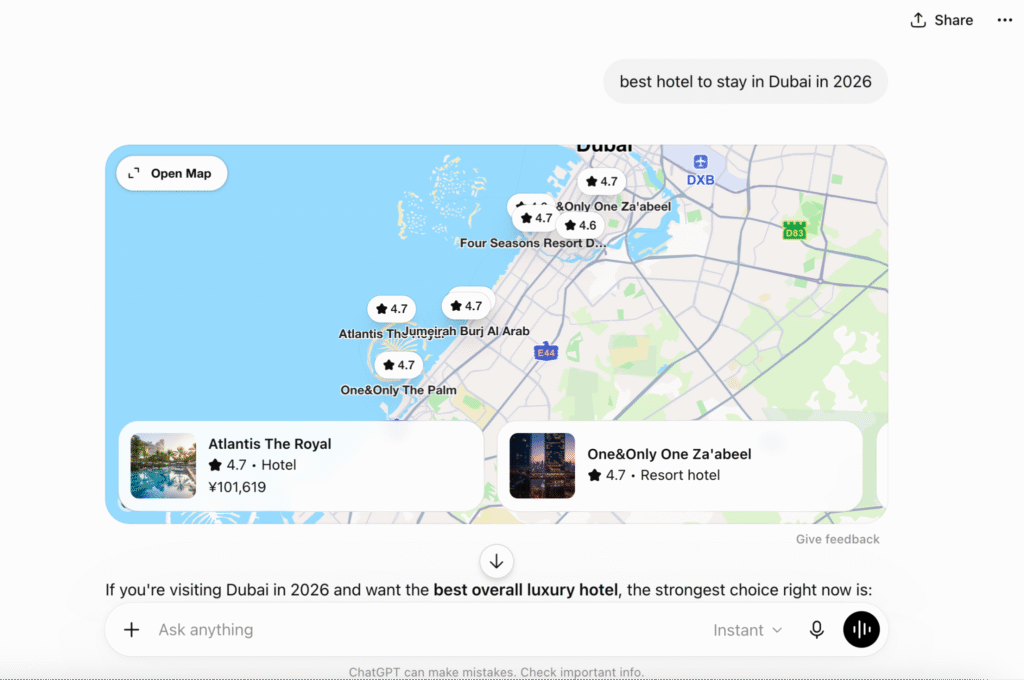
Bain & Company’s research puts a number on this. 80% of consumers rely on AI-generated summaries for at least 40% of their searches, and organic website traffic has fallen an estimated 15–25% across many sectors as a result.
For hotels, that’s a lot of decision-making happening off-site.
If a hotel’s digital marketing effort stops at its own website rankings, it risks missing exactly the stage where travelers are forming first impressions, comparing options and narrowing their shortlist.
None of this is happening in a quiet market, either. Dubai welcomed 19.59 million international overnight visitors in 2025, up 5% year-on-year, with average hotel occupancy reaching 80.7%. Record demand doesn’t ease the pressure on visibility, it raises the stakes for it.
Why Traditional Hotel SEO Is No Longer Enough
Hotel SEO hasn’t been replaced, it’s been outgrown. A hotel can still do everything right on the fundamentals and find itself missing from the moments that actually shape a booking decision. Here’s where the line sits in practice.
What Still Matters in Hotel SEO
Traditional SEO fundamentals remain the foundation of any hospitality marketing strategy:
- Technical health – fast load times, mobile usability and clean indexing still affect whether Google can find and trust your site.
- Local SEO signals – Google Business Profile accuracy, citations and proximity still drive “hotels near me” and neighbourhood-based searches.
- On-page optimisation – room pages, amenity pages and location pages still need to be structured clearly for both users and search engines.
- E-E-A-T signals – third-party recognition, press mentions and industry credibility still tell search engines which properties are worth trusting.
None of this goes away. It becomes the baseline, not the differentiator.
What Is Becoming Less Effective
Some tactics that used to move the needle now carry less weight on their own:
- Keyword stuffing or thin location pages – AI systems and modern algorithms reward useful content over repeated keyword phrases.
- Templated hotel descriptions – content that reads the same as ten competitor hotels does little to build trust or earn an AI citation.
- Chasing rankings without AI visibility – ranking #1 for a keyword matters less if travelers are getting their answer from an AI Overview.
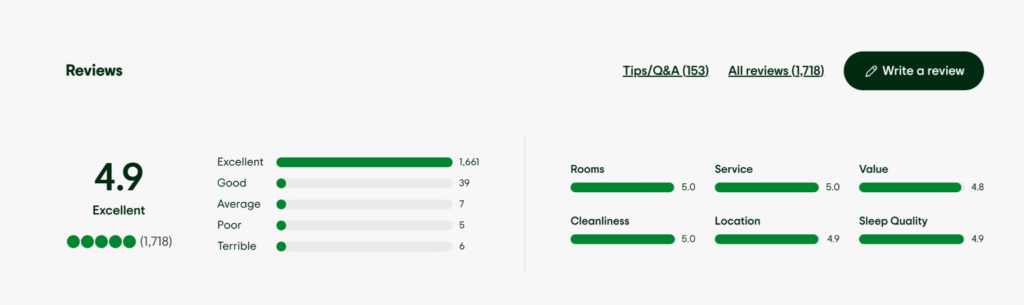
- Ignoring review platforms – a hotel that ranks well but has thin or outdated reviews is increasingly at a disadvantage, since review signals now feed both traveler trust and AI recommendations.
None of this means rankings stopped mattering. It means a hotel can rank well and still lose the traveler before they ever click through, which is exactly the gap Generative Engine Optimisation, or GEO, is built to close.
The Rise of GEO for Dubai Hotels
Most hotel SEO strategies are still built around one question.
How do we rank higher?
GEO reframes the question entirely.
How does a hotel become a source that search engines and AI systems trust enough to reference in the first place, regardless of where it ranks? That reframe matters for hospitality SEO.
A Dubai hotel’s goal is mainly to become a property that travelers, and the AI tools they’re increasingly consulting, can find, compare and trust at every stage of the booking journey, not just the final click.
What Is Generative Engine Optimization?
Generative Engine Optimization is the practice of improving how visible a brand is within AI-generated answers, rather than only within traditional search rankings.
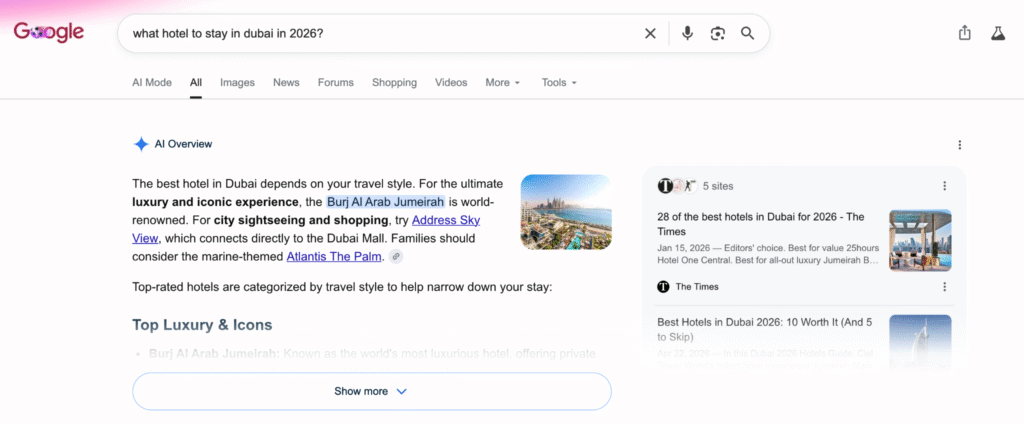
Tools like Google’s AI Overviews, AI Mode and chat-based assistants synthesise information from multiple sources with hotel websites, OTAs, review platforms, travel guides, to answer a traveler’s question directly.
For hotels, GEO is not a replacement for SEO.
It is an additional layer of visibility that sits alongside it. The properties most likely to benefit are those that publish accurate, detailed hotel content and maintain strong, consistent signals across their website, OTA listings, Google Business Profile and reviews.
Why GEO Matters for Hotel Discovery
Search has been quietly shifting from a keyword exercise to an entity exercise. The old question is being replaced by a more relational one.
“Which hotel is actually known for this, whether that’s a location, a room category, an experience or a pattern in guest sentiment?”
Answering that requires more than one signal. Search engines and AI systems are piecing together:
- where a hotel is located and what’s nearby
- what room types, amenities and experiences it offers
- how guests rate their stay, and on which specific aspects
- whether reputable travel sources mention or recommend it
- how consistent its information is across platforms
The stronger and more consistent those signals are, the easier it becomes for AI systems to confidently reference a hotel when a traveler asks a question.
How AI Search Is Changing the Traveler Journey
AI Overviews and Zero-Click Searches
One of the biggest shifts in search has been the rise of zero-click behaviour, where a traveler gets the answer they need directly on the results page without clicking through to any website.
Zero-click search has climbed steadily for years and now accounts for roughly 60% of Google searches, with AI Overviews accelerating that trend further on informational queries.
For travel-related searches specifically, this matters but plays out differently than in other categories. Travel is a transactional category, a traveler still needs to land somewhere to actually book a room.

Industries with strong transactional intent, including travel and e-commerce, tend to show smaller increases in zero-click behaviour than purely informational categories like health or recipes, because the booking step still requires a destination site.
That said, AI Overviews are increasingly answering the research-stage questions before a traveler ever compares hotels directly:
- “What’s the best area to stay in Dubai for first-time visitors?”
- “Which Dubai hotels have private beach access?”
- “Is Dubai Marina or Downtown Dubai better for families?”
- “What’s included in a 5-star Dubai hotel stay?”
If a hotel’s content doesn’t answer these questions clearly, it risks being absent from the moment travelers are forming their shortlist, well before they reach a booking page.
AI Travel Recommendations

Beyond Google, travelers are increasingly using conversational AI tools to plan trips, asking for hotel recommendations based on budget, travel dates, group size or specific preferences like proximity to the beach or business districts.
This is becoming part of a broader shift toward AI-assisted travel planning, where AI functions less like a search engine and more like a planning co-pilot across the entire trip lifecycle.
For hotel digital marketing teams, this means visibility now depends on more than a hotel’s own website. It depends on whether AI systems have access to clear, structured, and consistent information about the property across the wider web.
Reviews, Listings, and Third-Party Signals
Reviews have always mattered in hospitality. They matter more now, because both travelers and AI systems rely on them heavily.
Here’s what the recent data shows:
- 92% of guests read reviews before booking a hotel.
- 70.9% of travelers say online reputation influences their choice of accommodation.
- 55% of travelers say they will avoid a hotel with consistently poor ratings.
Review platforms have also changed how they calculate scores.
Booking.com’s updated scoring model, rolled out in 2025, now weights recent guest experiences more heavily than historical averages, meaning a hotel’s score can shift faster based on recent service quality, for better or worse.
For hotels, this means reputation management is no longer a “set and monitor occasionally” task. It is an ongoing signal that both travelers and AI systems treat as current, not historical.
Why Hotel Digital Marketing Must Focus on Direct Bookings
Visibility Before the Booking Platform
Most hotel digital marketing conversations eventually return to one question.
How much of this visibility actually translates into hotel direct bookings, rather than bookings through an OTA?
The earlier in the journey a hotel can build trust and visibility, the more chance it has of being the property a traveler searches for by name, rather than one they discover only by scrolling through an OTA results page.
This is sometimes called the billboard effect: a hotel appears on an OTA, a traveler notices it, and later searches for it directly. In 2026, that effect still works, but only if the hotel has a strong direct search and AI presence to capture that follow-up search.
Without it, the traveler often just books through the OTA they found it on instead.
Reducing Dependence on OTAs
OTAs remain a major part of hotel distribution, and that isn’t changing. But the economics make direct visibility worth investing in:
- OTA commission rates typically range from 15% to 25%, and can reach 25–30% when promotional placements are included.
- Direct booking acquisition costs, by comparison, typically run between 2% and 12% of booking value when managed through SEO and owned channels.
- Direct bookers tend to be more valuable over their lifetime, often booking premium room categories and showing stronger repeat-booking behaviour.
This doesn’t mean hotels should abandon OTAs.
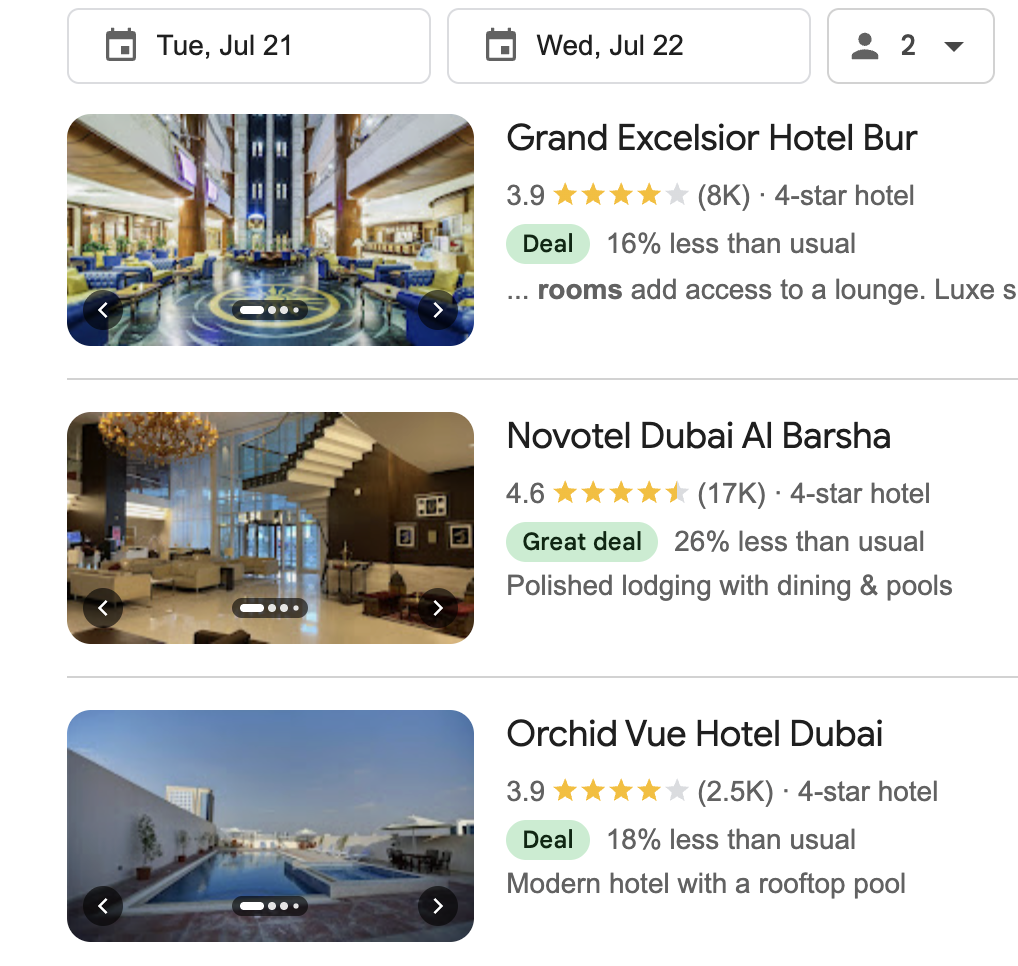
26% of travelers now begin their accommodation search on an OTA, compared to 21% who start on Google, so OTA visibility still drives real discovery. But hotels that shift even a modest share of bookings from OTA to direct channels typically retain meaningfully more revenue per booking.
The strongest hotel digital marketing strategies in 2026 use OTAs for reach and discovery while building direct SEO and GEO visibility to capture and convert demand without paying commission on every booking.
The New Search Signals Dubai Hotels Should Prioritize
Review Quality and Sentiment
Review volume still matters, but sentiment and recency now carry more weight. AI systems and modern review scoring models increasingly favour hotels with consistent, recent positive feedback over those relying on a strong historical average. Responding professionally to reviews, both positive and negative, also contributes to how trustworthy a property appears.
Google Business Profile and Local SEO
Local SEO has not lost relevance, if anything, it has become more foundational. An accurate, fully optimised Google Business Profile, consistent NAP (name, address, phone) data across directories, and location-specific content all continue to influence both traditional rankings and how confidently AI systems can describe a hotel’s location and offerings.
Structured Data and Hotel Website Optimization
Hotel website optimization now includes more than page speed and mobile usability. Structured data like schema markup for hotels, room types, pricing, amenities and reviews helps search engines and AI systems accurately parse what a hotel offers.
Hotels that implement clean, accurate schema make it easier for their information to be surfaced correctly in rich results, AI Overviews and voice-based answers.
Entity Authority and Brand Mentions
AI systems build confidence in a hotel as an “entity” through mentions across multiple credible sources like travel publications, tourism board features, hospitality awards, and reputable directories.
Image Here
A hotel that is mentioned consistently and accurately across these sources is more likely to be referenced confidently by AI tools than one that only exists on its own website and OTA listings.
Helpful Destination and Experience Content
Travelers don’t only search for hotels. They search for experiences, neighbourhoods and practical travel questions:
- “Best hotels near Dubai Marina for couples”
- “Family-friendly hotels with kids’ clubs in Dubai”
- “Hotels within walking distance of Dubai Mall”
Hotels that publish genuinely useful destination and experience content written with real local knowledge have more opportunities to be discovered and referenced earlier in the research journey.
What Dubai Hotel Marketing Teams Should Do Next
Strengthen Hospitality SEO Foundations
Before layering on GEO strategy, the fundamentals need to be solid. Fast, mobile-optimised websites, accurate local listings, clean technical SEO and well-structured room and amenity pages. Hospitality SEO without this foundation will struggle to build the authority GEO depends on.
Create AI-Friendly Hotel Content
Structure content to directly answer the questions travelers are asking about location, amenities, room types, policies and nearby experiences. Clear, well-organised, fact-based content is easier for AI systems to extract and reference accurately than dense marketing copy.
Improve Review and Reputation Signals
Make review generation and response part of standard operations, not an occasional task. Consistent, recent, well-managed reviews influence both traveler decisions and how confidently AI systems recommend a property.
Optimize for Direct Booking Conversion
Visibility only pays off if it converts. That means a fast, mobile-friendly booking engine, clear rate parity with OTAs, and compelling reasons for travelers to book directly, such as exclusive perks, flexible cancellation or loyalty benefits, once they do land on the hotel’s own site.
Preparing Dubai Hotels for SEO and GEO in 2026
None of this points to a single trend hotels need to chase.
It points to a slower, more durable shift. The properties that win visibility going forward will be the ones that are consistently credible, in their own content, in how AI systems describe them, and in what guests say after they’ve stayed.
That’s a harder thing to fake than a keyword ranking.
It’s also harder to lose once it’s built, which is exactly why it’s worth building now, while Dubai’s hotel market is still growing and the competition for attention is only getting more crowded.
Treating SEO as a rankings exercise alone leaves a lot of that visibility unclaimed.
The more useful question is whether a hotel shows up credibly everywhere a traveler is actually looking: Google, AI answers, reviews, OTA listings and the hotel’s own site.
In practice, this means having strong hospitality SEO basics for hospitality and a direct booking experience can turn a visitor into a guest.
Get those four right, and the rest of 2026’s algorithm shifts become far less disruptive to navigate.