
Answer engine optimization is becoming a useful way to describe a simple change in search behaviour.
Sometimes that answer appears as one of Google’s featured snippets.
Sometimes it appears inside Google AI Overviews or AI Mode.
On other platforms, a user may ask a question and receive a generated response that cites, recommends or summarises information from several sources. That changes what visibility looks like, but it does not make traditional SEO irrelevant.
The strongest answer-led results still depend on crawlable pages, useful content, clear expertise and information that a search system can understand well enough to retrieve and trust.
The opportunity is not to write for robots or force every paragraph into a 40-word answer box, but to make the important parts of your content easy to identify, verify and reuse without making the page worse for the person who actually lands on it.
What is answer engine optimization?
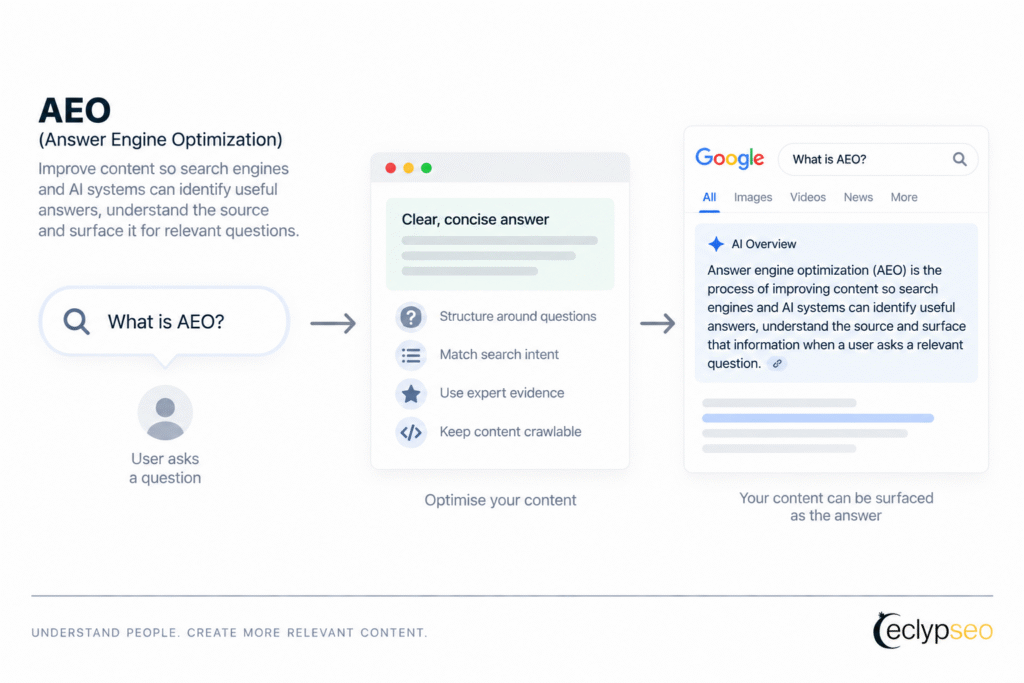
Answer engine optimization (AEO) is the process of improving content so search engines and AI systems can identify useful answers, understand the source behind them and surface that information when a user asks a relevant question.
The phrase is newer than the underlying work.
SEOs have been structuring pages around questions, search intent, concise definitions, expert evidence and crawlable content for years. What has changed is the number of places where those answers can appear.
A page can now earn visibility through a traditional result, a featured snippet, a People Also Ask result, an AI Overview, AI Mode or a separate answer engine. Each system works differently, so there is no universal piece of markup or single formatting rule that guarantees inclusion.
This is why good answer engine SEO should be treated as an extension of SEO rather than a replacement for it.
AI and GEO optimisation service follows the same principle: strengthen the content, technical and authority signals that make a business genuinely easier to understand and recommend.
Featured snippets and AI answers are not the same thing.
The terms are often grouped together because both can answer a question directly in the search experience. The systems behind them are different.
Google describes a featured snippet as a special search result where the descriptive snippet appears before the link. Google also makes one important point very clear: you cannot mark a page as a featured snippet. Its systems decide whether a page is suitable for a particular search.
Google’s featured snippet documentation also explains that site owners can limit or block snippets, but cannot request one.
Area | Featured snippet | AI-generated answer |
What it does | Extracts a concise answer from a web result | Generates a response using information retrieved from one or more sources |
Source selection | Google selects a suitable page for the query | Can retrieve several sources and related subqueries |
Can you mark up for it? | No special featured-snippet markup | No special AI Overview or AEO schema |
Best foundation | Clear answer, relevant page, strong SEO | Crawlability, useful evidence, relevance, authority and strong SEO |
Google’s current generative-search guidance says its AI features are rooted in the core Search ranking and quality systems. They can use retrieval-augmented generation and query fan-out to gather information from the Search index before creating a response.
That makes AI answers broader and less predictable than a single extracted snippet. Google’s 2026 AI optimisation guide is explicit that normal SEO best practices remain foundational.
Step 1: Find questions where a direct answer is genuinely useful
The first step in AEO is not rewriting every introduction. It is identifying searches where a concise answer actually helps the user. Definitions, comparisons, costs, requirements, timings, processes and “how does this work?” searches often have clear answer intent.
A query such as “what is a canonical tag?” can be answered directly before the page expands into implementation detail. A query such as “best CRM for an engineering consultancy” is more complex and may need criteria, alternatives and evidence before any useful recommendation can be made.
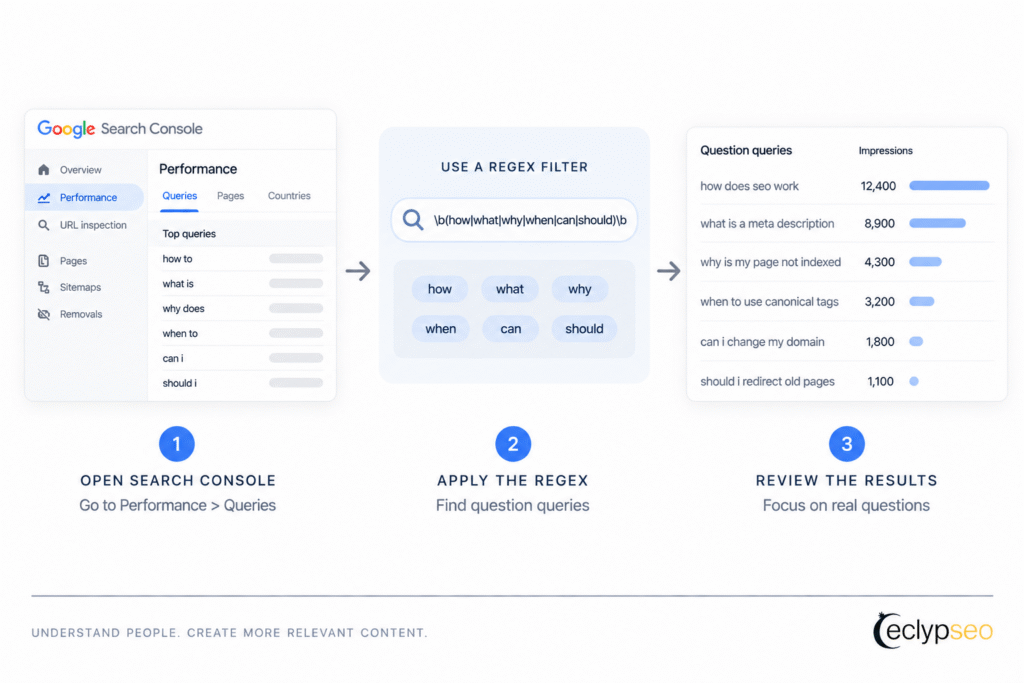
Start with the questions already appearing in Google Search Console. Our search Console regex guide shows how to isolate query patterns containing terms such as how, what, why, when, can and should without manually reading thousands of rows. Then inspect the live results.
If Google repeatedly shows concise paragraphs, tables, product results, videos or local packs, that gives you information about the format and intent it currently associates with the query. This is also where featured snippet optimization becomes more practical.
You are not chasing a box. You are identifying questions where your page can provide a clearer answer than the pages Google currently has available.
Step 2: Give the answer early, then earn the depth
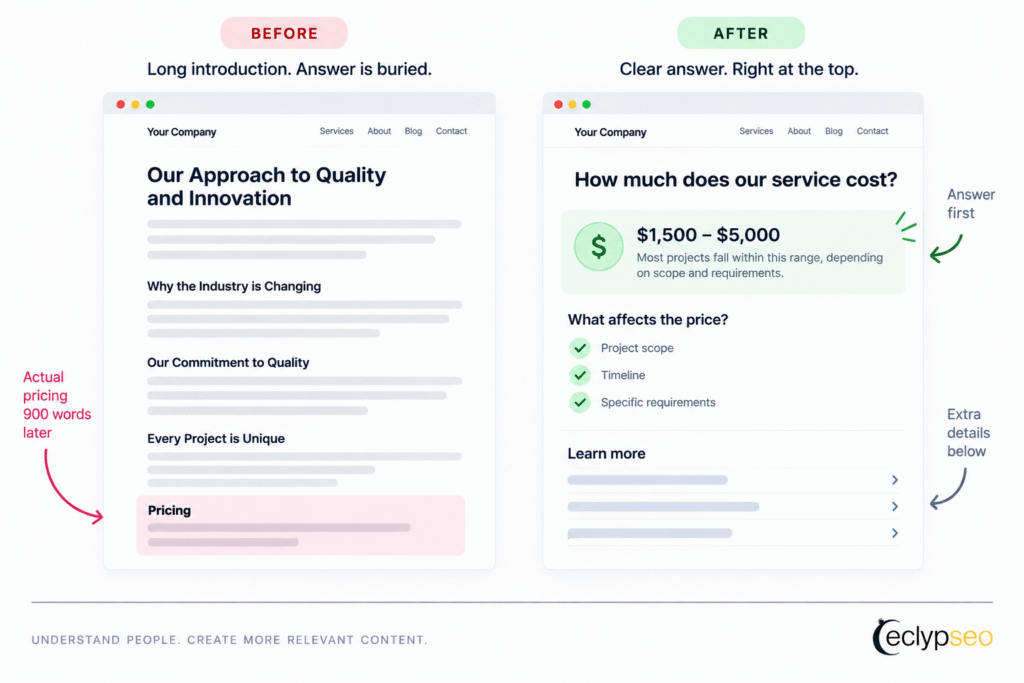
Pages often make simple questions unnecessarily difficult to answer. A user searches for the average cost of a service and lands on an introduction explaining why the industry is changing, why the company cares about quality and why every project is unique. The actual pricing range appears 900 words later.
That structure is frustrating for readers and makes the core answer harder to extract. Where a question has a concise answer, provide it close to the relevant heading. Then add the qualifications, examples, exceptions and commercial context that make the answer genuinely useful.
If the question is “How long does an SEO migration take?”, the first paragraph can give the realistic range and the main variables. The rest of the section can explain site size, crawl frequency, redirect mapping and monitoring. The direct answer earns attention; the depth earns trust.
This is one of the most reliable ways to optimize content for featured snippets without turning the page into a series of disconnected one-line paragraphs. Eclypseo’s content marketing service applies the same principle more broadly: answer the search intent clearly, then support it with useful evidence and a sensible commercial journey.
Step 3: Structure content around the user’s next questions
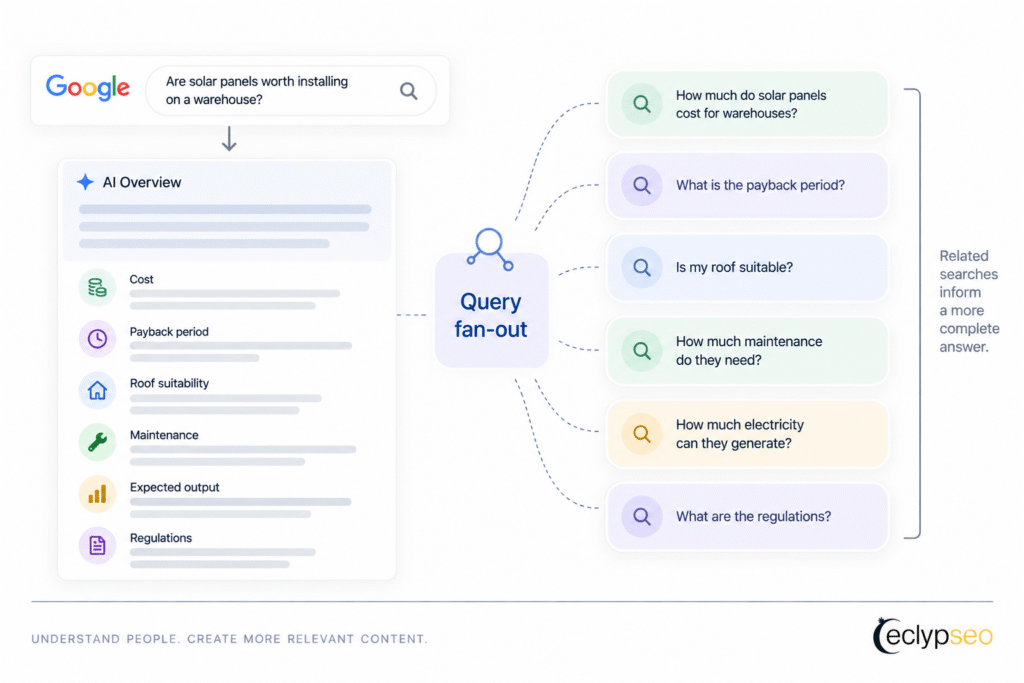
Answer engines rarely operate around one isolated keyword. Google says AI Overviews and AI Mode can use query fan-out, issuing related searches across subtopics to build a response.
A user asking whether solar panels are worth installing on a warehouse may also need cost, payback, roof suitability, maintenance, output and regulatory information. That means a strong page should answer the primary question and the important questions that naturally follow it.
This does not mean publishing a separate page for every wording variation. It means organising one useful resource around the decision the user is trying to make.
Use descriptive H2s and H3s where they improve navigation. Keep paragraphs focused enough that the main point is clear, but do not force every section into artificial “AI chunks”. Google specifically says there is no need to create special AI-only files or reshape content around arbitrary answer lengths.
The objective behind how to appear in AI answers is therefore less about formatting tricks and more about coverage. If your page answers one small part of a decision while another source provides the definition, evidence, comparison and limitations, the second source gives an answer engine much more to work with.
Step 4: Make important claims easy to verify
A concise answer is useful only if it is believable. When a page makes factual claims about prices, regulations, health, product performance or industry trends, support the important claims with the strongest source available. Government guidance, official documentation, original research and transparent first-party data normally provide a stronger foundation than a chain of blogs repeating one another.
Your own experience can be evidence too, but explain it properly. “We improved conversion rates by 40%” is far less useful than explaining the original baseline, what changed, the timeframe and what else may have influenced the result. This is especially important for AI search visibility because generative systems may retrieve a specific claim from deep inside a page rather than treat the entire article as one ranking unit.
Our guide getting featured on AI search engines goes deeper into the relationship between entity clarity, first-hand expertise, third-party authority and content that answer engines can confidently reference.
Step 5: Make sure the page is technically eligible to be used
No amount of answer formatting helps if the page cannot be crawled or indexed. For Google’s AI features, the requirement is straightforward: the page needs to be indexed and eligible to appear in Google Search with a snippet. Google says there are no additional technical requirements created specifically for AI Overviews or AI Mode.
That puts ordinary technical SEO back at the centre of the strategy. Check robots directives, noindex tags, canonicals, server responses, JavaScript rendering, internal links and whether the content is actually available to Googlebot.
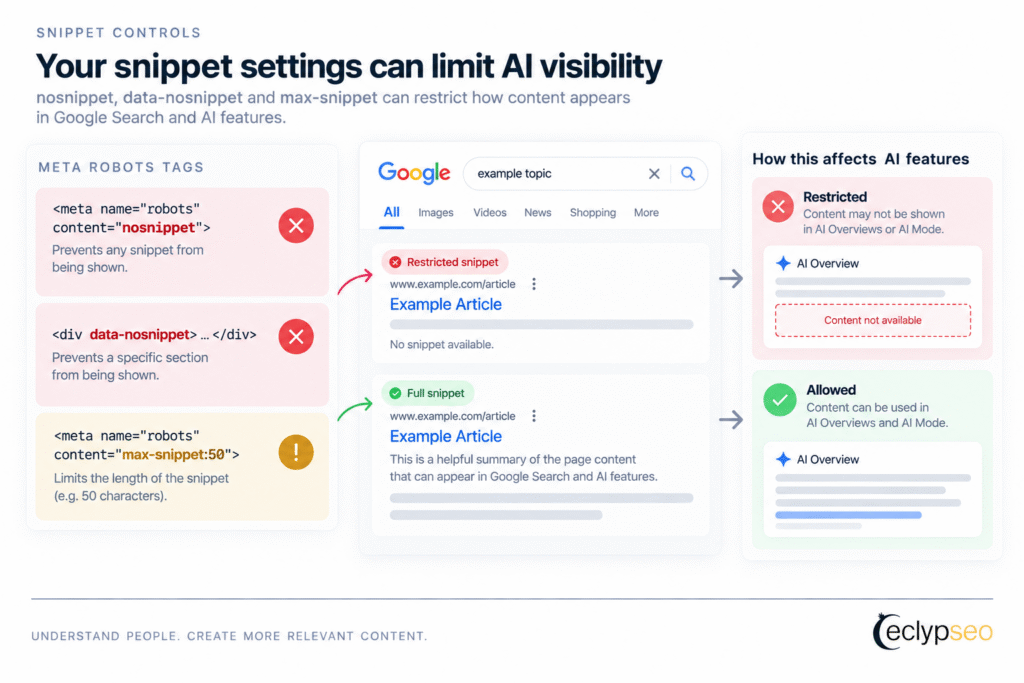
Snippet controls also matter. Google’s AI features documentation confirms that nosnippet, data-nosnippet and max-snippet can restrict how content is displayed in both normal Search and AI features. A restrictive setting added years ago can therefore work directly against the visibility you are trying to create. Eclypseo’s technical SEO service reviews these foundations across crawlability, indexation, site structure, structured data and internal linking rather than treating AEO as a separate technical discipline.
Step 6: Use structured data for clarity, not as an AEO shortcut
Structured data can help Google understand information about products, organisations, articles, authors, events and other entities. It can also make eligible pages available for certain enhanced search appearances. What it cannot do is guarantee a featured snippet or AI citation. There is no special “AEO schema” for featured snippets, and Google says no special schema is required for its generative AI features.
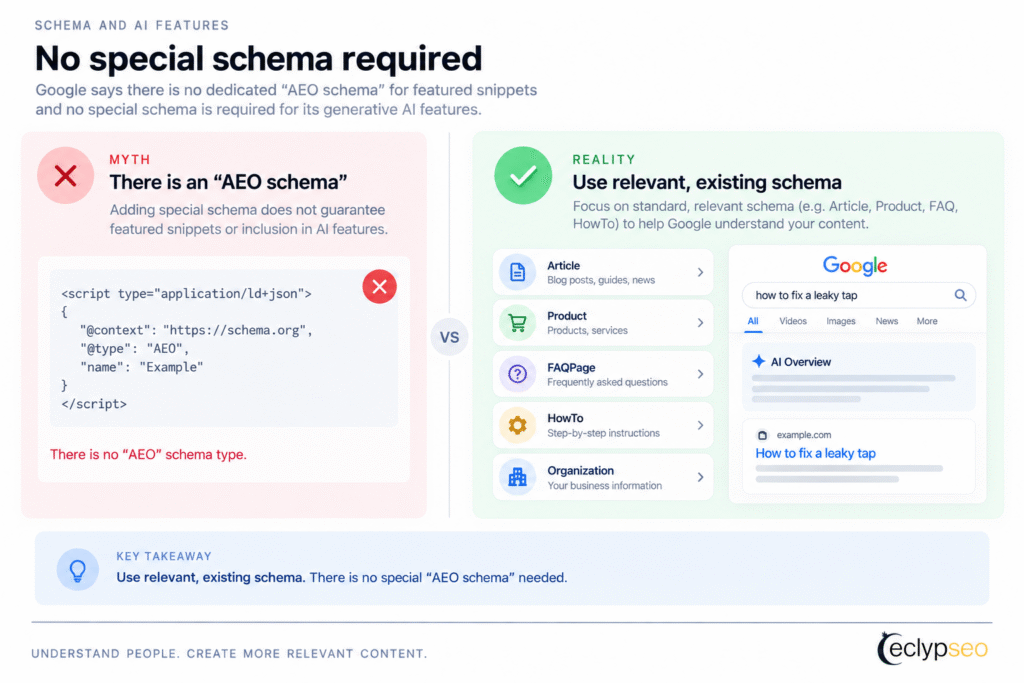
Markup should describe information that genuinely exists on the page rather than being added because a plugin promises better AI visibility. This has become more important as older tactics lose relevance. Google discontinued the FAQ rich-result feature in Search on 7 May 2026.
That does not mean questions and answers stopped being useful content; it means adding FAQ markup should not be treated as a guaranteed method of occupying more search-result space. Use structured data because it improves machine-readable clarity and is appropriate for the content type. Keep the visible page accurate first.
Step 7: Build enough authority for your answer to be worth selecting
Good formatting cannot manufacture expertise. If an unknown website publishes a paragraph about a complex financial rule while an official regulator publishes the same information with clearer context, the authority gap matters. The same is true in less regulated industries. Search systems need reasons to trust the source behind the answer.
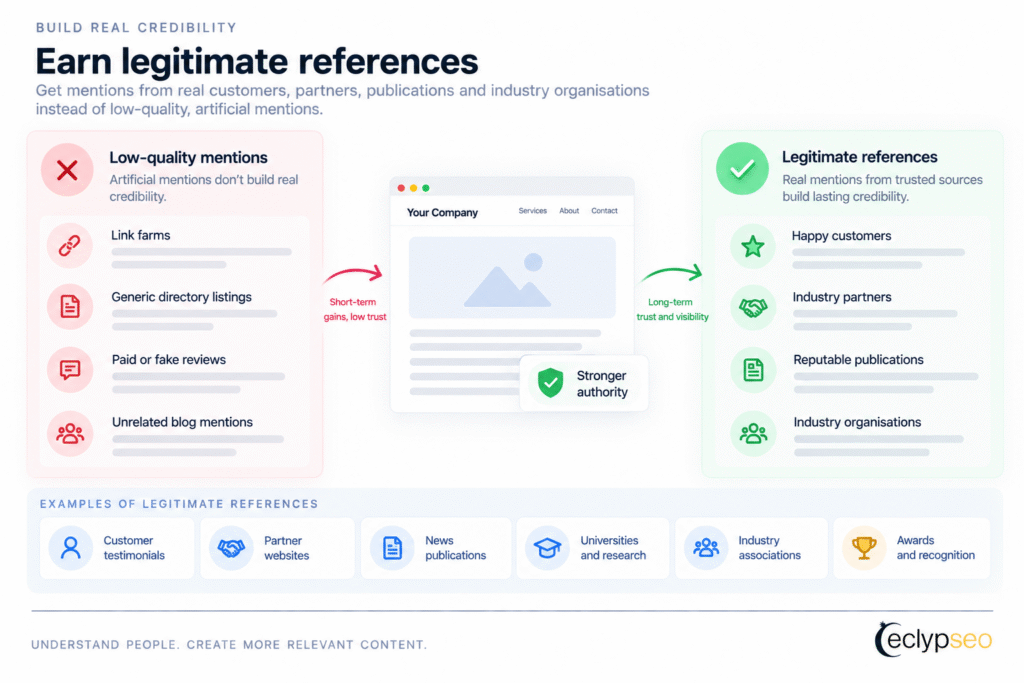
Earn legitimate references from customers, partners, publications and industry organisations instead of trying to build an artificial footprint through low-quality mentions.
Internal links matter too.
A page about technical SEO that is connected naturally to related guides, services and case studies sits within a clearer subject area than the same page left isolated inside a large blog archive. This is where answer engine SEO becomes a site-wide exercise. The answer may come from one paragraph, but the confidence around that paragraph is influenced by the quality and clarity of the wider website.
How do you measure answer engine optimization?
Measurement is improving, but it still requires more than one metric. For traditional featured snippet optimization, Search Console can show the queries and pages receiving impressions and clicks, while manual SERP checks can confirm whether the snippet is actually present.
Avoid treating one temporary snippet win as permanent; Google can change the selected result as the query, index and competing pages change. For Google’s generative features, measurement became more useful in 2026. Google introduced dedicated Generative AI performance reports in Search Console in June and confirmed on 31 August 2026 that the insights had rolled out to websites worldwide.
The reports provide dedicated visibility into impressions from AI Overviews and AI Mode, including breakdowns by page, country, device and date. Google’s announcement explains the current reporting in more detail. Our guide to Google Search Console’s AI visibility reporting explains how to interpret that data alongside wider organic visibility. The commercial measurement still matters most.
Google AI Overviews impressions are useful, but the objective is not to accumulate AI exposure for questions that have no relationship to your business. Track whether answer-led visibility supports branded demand, qualified traffic, enquiries, demos, sales or another outcome that matters.
What should you avoid when trying to win AI answers?
Avoid building an AEO strategy around shortcuts that have no clear relationship to how the systems actually work. You do not need an AI-only version of every page, and there’s no need to separate page for every long-tail question.
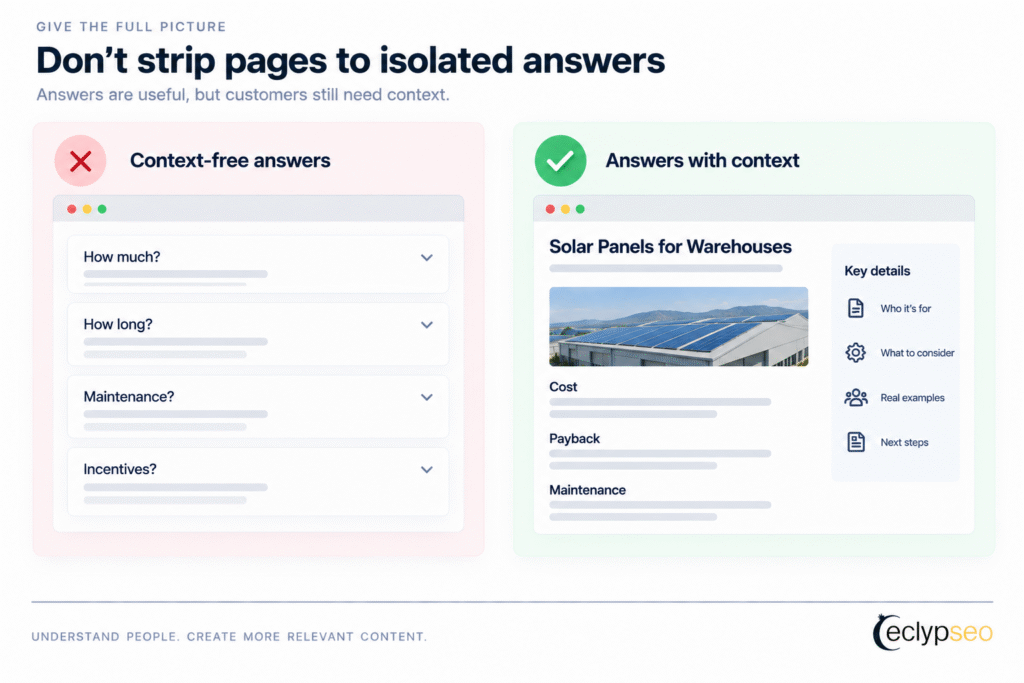
You should also avoid reducing useful pages to a sequence of context-free answer blocks. An answer engine may value extractable information, but the customer still needs enough context to understand whether the answer applies to them. The strongest AEO work usually looks less dramatic: clearer questions, better answers, stronger evidence, cleaner technical access and more distinctive expertise.
Answer engine optimization works best when the page deserves to be the answer
The shift towards answer-led search is real, but the fundamentals are less exotic than the terminology suggests. To improve AI search visibility, make the content easy to access, make the central answer easy to identify and make the supporting evidence difficult to dismiss.
Structure the page around real customer questions rather than keyword variations. Use structured data accurately. Build authority around the subject. Then measure whether those gains lead to commercially useful visibility.
The same approach can support featured snippets, Google AI Overviews and other answer-led search journeys without creating a second content strategy that fights against your existing SEO. That is the practical answer to how to appear in AI answers: become a stronger source for the questions your customers actually ask, then give search systems enough clarity and evidence to use you confidently.
Find out whether your content is answer-ready
If your pages rank but rarely appear in featured snippets, AI Overviews or other answer-led results, the problem may sit in the content structure, technical eligibility, evidence or wider authority rather than one missing optimisation. Eclypseo combines content strategy, AI optimisation and technical SEO to identify which questions matter commercially and what is limiting your visibility. You can book an SEO consultation to review where answer-led search fits into your wider organic growth strategy.