
The family-run business offers restored country cottages near Ripon, surrounded by the North Yorkshire countryside and within reach of destinations including Harrogate, York and the Yorkshire Dales.
The cottages had attractive interiors, strong guest feedback and a location people were actively searching for.
The problem was the website.
It could process bookings, but it did not give the business enough control over how its cottages were presented, how pages were structured or how search engines discovered the content.
Following a complete website rebuild, organic impressions increased from 4.69K to 11.6K when comparing the latest three months with the previous three months.
That represents a 147% increase, or approximately 2.5x more organic search visibility.
Organic clicks also increased by 57%, while the website’s average Google position improved from 19.1 to 11.9.
This is how we turned a restrictive UK holiday cottage brand website into a more flexible platform built for search visibility, usability and direct booking growth.
The Results at a Glance
Comparing the latest three months with the previous three months, Givendale Cottages achieved:
- 2.5x more organic impressions
- 147% growth in organic visibility
- 57% increase in organic clicks
- A 7.2-position improvement in average rankings
- Average position moving from 19.1 to 11.9
The wider website project also delivered a 250% increase in page indexation, a 50% improvement in engagement and dwell time, and a complete design overhaul within three weeks.
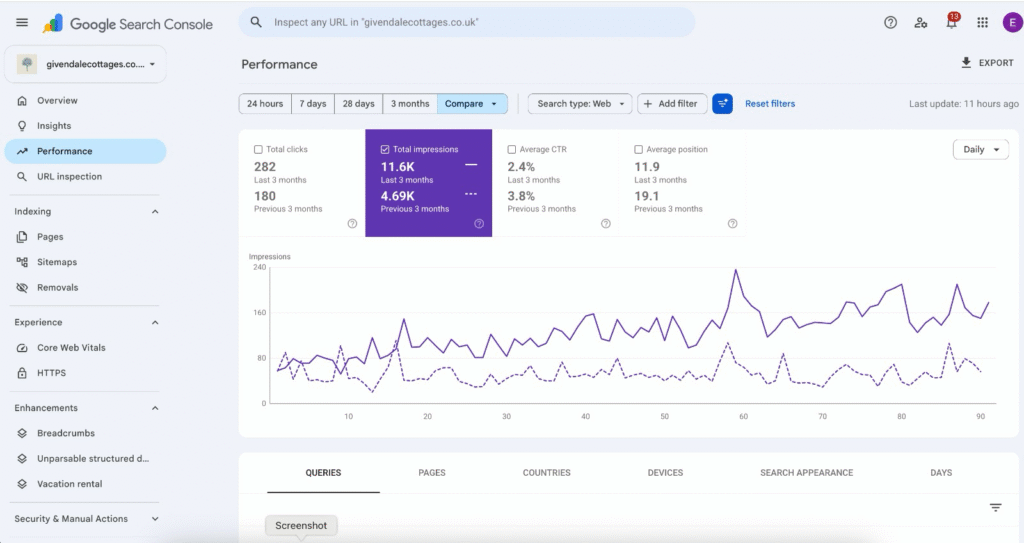
Organic impressions increased from 4.69K to 11.6K, while clicks rose by 57% and average position improved from 19.1 to 11.9.
Who Are Givendale Cottages?
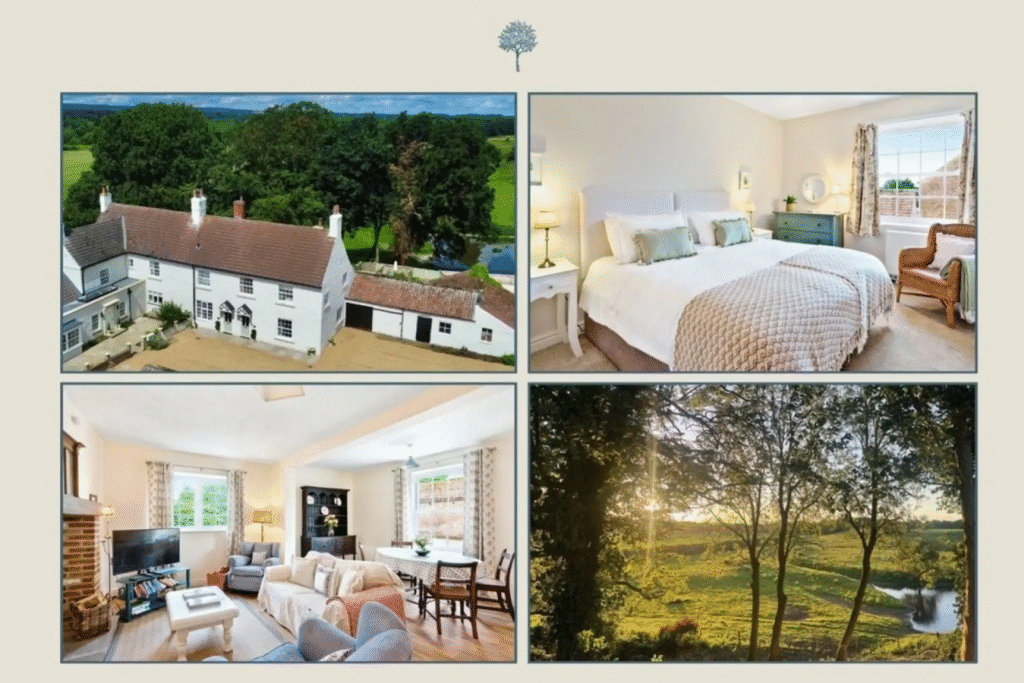
Givendale Cottages is a family-run holiday accommodation business located near Ripon in North Yorkshire.
The properties sit on the Newby Hall Estate and include Moat Cottage, which sleeps four, and Chantry Cottage, which sleeps five. Guests can also book both properties together for a group of up to nine.
The cottages are positioned around countryside stays, restored character, dog-friendly accommodation and access to nearby destinations and attractions.
Their website also features verified Airbnb reviews, giving potential guests additional proof from people who have already stayed at the properties.
It was a strong hospitality product being held back by a website that was too restrictive.
The Original Website Worked, but It Could Not Grow
Givendale Cottages previously operated through a Hostaway-powered website.
Hostaway served an important operational purpose. It helped manage accommodation availability and bookings.
But the website itself prioritised booking functionality over marketing flexibility.
The structure offered limited control over:
- Page titles and metadata
- Content hierarchy
- Internal links
- URL structures
- Landing-page creation
- Search-intent optimisation
- The wider guest journey
Important pages lacked enough depth, and the business had no scalable way to create new accommodation, location or local-experience content.
From a technical perspective, indexing was inconsistent. Templated layouts, limited crawl controls and reliance on scripts made it harder for search engines to understand which pages were important.
The site functioned as a booking tool.
It did not function as a strong holiday accommodation website capable of attracting new guests through organic search.
We Moved the Website From Hostaway to WordPress
The main solution was a complete holiday rental website migration to WordPress.
Hostaway remained integrated for availability, pricing and booking functionality, but WordPress became the main customer-facing website.
This gave the business significantly more control over design, content and technical performance.
Instead of trying to force SEO improvements into a rigid template, we rebuilt the platform around what potential guests needed to know before making a booking.
The new setup allowed us to improve:
- Site architecture
- Page hierarchy
- Internal linking
- Crawlability
- Indexation
- Page speed
- Content scalability
- Calls to action
- The path from research to booking
The migration was not about replacing a booking system that worked.
It was about separating the operational booking technology from the website responsible for attracting and converting guests.
This is an important distinction in WordPress SEO migration projects. A website can retain the tools the business needs behind the scenes while creating a more flexible front end for search engines and customers.
We Rebuilt the Site Around How Guests Search
People rarely search only for the name of a cottage they already know.
They search around locations, stay types, group requirements, attractions and the type of experience they want.
Examples might include:
- Country cottages near Ripon
- Dog-friendly cottages in North Yorkshire
- Accommodation near Newby Hall
- Yorkshire cottages for families
- Rural stays near Harrogate
- Cottages for groups near the Yorkshire Dales
The old structure made it difficult to create useful pages around those different needs.
The new website introduced clearer landing pages built around themes such as location, accommodation type and local experiences.
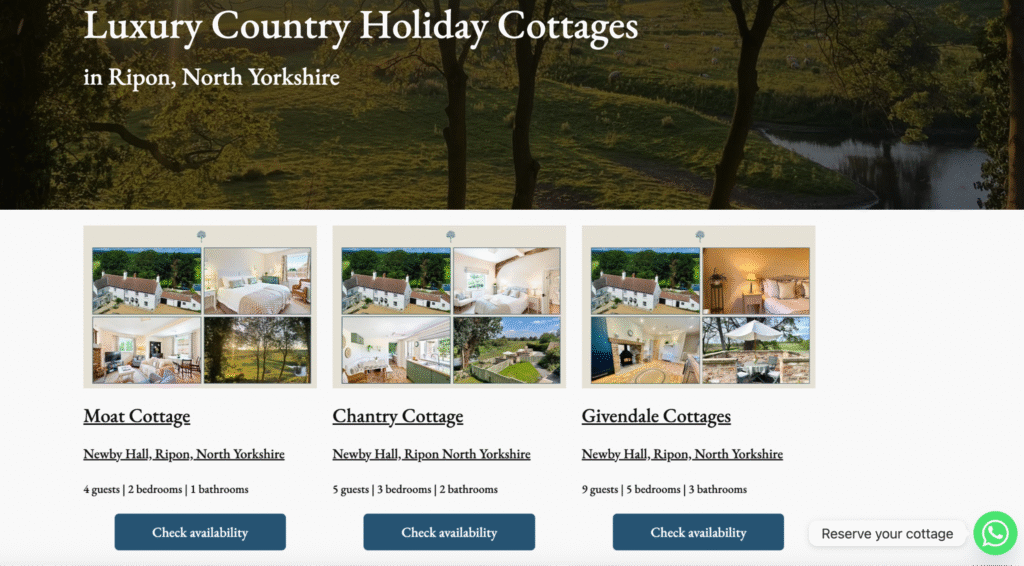
That gave search engines more context around what Givendale Cottages offered and gave potential guests a more useful journey.
Someone discovering the site through a destination search could now move naturally towards:
- Understanding the location
- Comparing the cottages
- Reviewing facilities and guest feedback
- Checking availability
- Making a booking
Strong content marketing is not about publishing generic travel articles for volume.
For a holiday accommodation business, the most useful content helps people decide whether the property is right for their stay.
We Made the Priority Pages Easier to Crawl and Index
A page cannot generate organic visibility when Google cannot reliably find, understand or index it.
The rebuild introduced cleaner URL structures, improved crawlability and clearer signals around which pages should be prioritised.
Internal links were used to connect cottages, destination information and supporting content more logically.
This matters because search engines use internal links to understand both relationships and importance. A cottage page buried several clicks deep with few contextual links is easier to overlook than one supported by relevant location and experience pages.
The work contributed to a 250% increase in page indexing.
The goal was not to force every available URL into Google.
It was to make the pages with genuine value easier to discover and more worthy of being indexed.
Our guide to indexation and crawl-budget issues explains why search engines may ignore pages with unclear hierarchy, weak internal links, overlapping content or technical instability.
We Improved the Experience From Browsing to Booking
Search visibility alone was not enough.
Accommodation is a considered purchase. Guests normally want to understand the property, location, sleeping arrangements, surroundings and booking terms before committing.
The old website offered limited flexibility around navigation and page layout.
The new design made it easier to:
- Compare the available cottages
- See guest capacity and bedroom information
- Understand the location
- Review property features
- Read guest feedback
- Explore nearby experiences
- Find availability and booking actions
Calls to action were made clearer, and the journey from discovering the property to checking availability became more natural.
The rebuild led to a reported 50% increase in dwell time and engagement, suggesting that visitors were interacting more deeply with the new experience.
This is where conversion rate optimisation and SEO overlap.
Better organic visibility brings people to the website.
Better UX gives those visitors a reason to stay, trust the accommodation and move towards a booking.
What the Search Console Results Actually Mean
Google Search Console reports four core performance metrics:
- Clicks
- Impressions
- Click-through rate
- Average position
An impression is recorded when a website appears in Google’s search results. A click is recorded when someone selects the result and visits the website.
Average position reflects the average highest position recorded across the searches where the property appeared. It should not be interpreted as every keyword ranking in exactly the same place.
For Givendale Cottages, impressions increased from 4.69K to 11.6K.
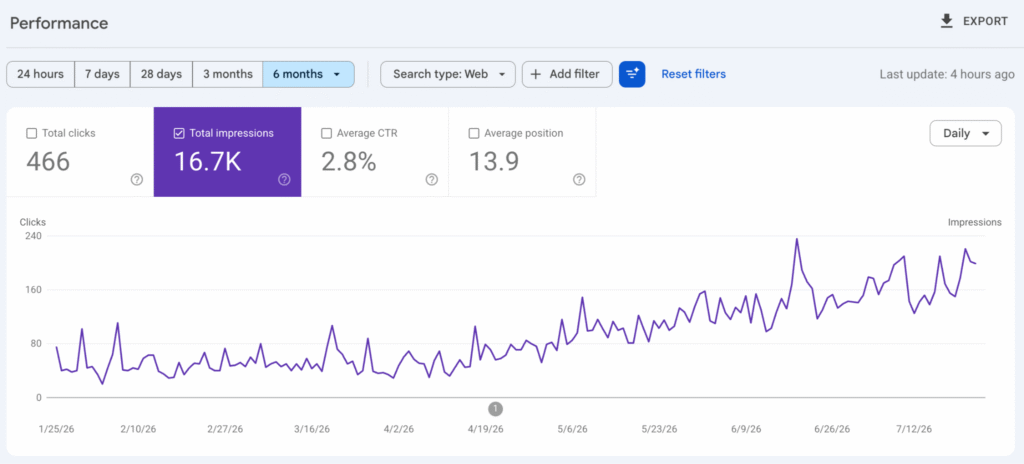
This shows that the website appeared in search results approximately 2.5 times as often as it had in the previous comparison period.
Clicks rose by 57%, meaning the additional visibility also brought more people to the site rather than simply creating passive appearances.
Average position improved from 19.1 to 11.9.
In practical terms, the site moved from an average position around page two towards the border of page one.
That does not mean every page reached position 11.9. It means the website’s overall search presence became substantially more competitive.
Google itself recommends using impressions and clicks as primary measures of search performance while treating average position as supporting context.
Why Impressions Grew Faster Than Clicks
The screenshot shows that visibility increased faster than clicks.
That pattern is not automatically a concern.
When a website begins appearing for a wider set of searches, many of those new impressions may initially occur lower on the results page.
The site can therefore gain substantial visibility while the newer queries are still moving towards stronger positions.
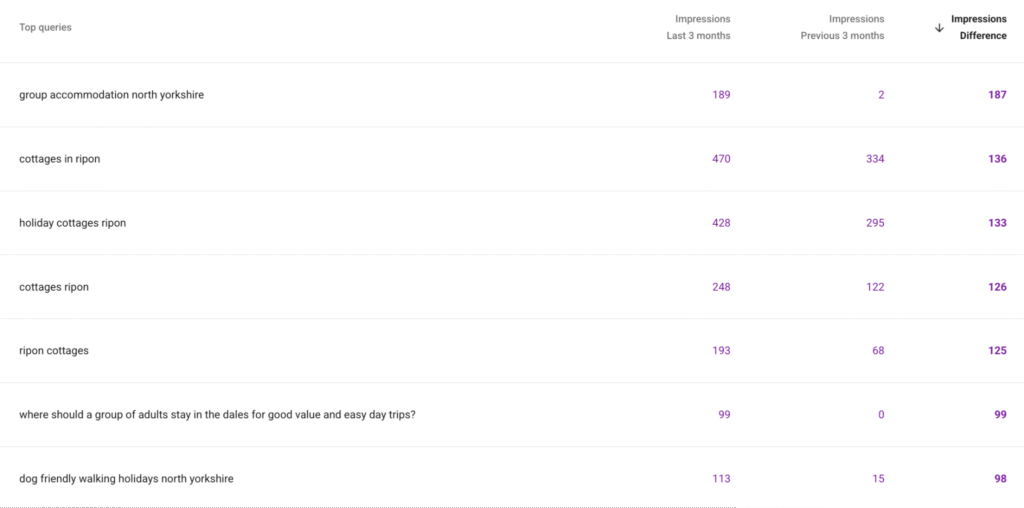
The next step is normally to review the queries and pages responsible for the additional impressions.
That analysis can reveal:
- High-impression searches sitting just outside page one
- Pages that need stronger titles and descriptions
- New destination or accommodation themes worth expanding
- Searches attracting visibility but limited clicks
- Commercial queries that should be prioritised
The three-month comparison proves that reach and traffic increased.
Query-level data would tell us where the next round of growth is most likely to come from.
Why the CMS Migration Worked
The result did not come from changing platforms for the sake of it.
WordPress was useful because it removed the restrictions preventing the website from being properly optimised.
The migration created the foundation for:
- More reliable indexation
- Better information architecture
- Faster content improvements
- Dedicated landing pages
- Cleaner internal linking
- Stronger destination relevance
- Better page experiences
- Clearer booking journeys
The website became easier for search engines to crawl and easier for guests to use.
Those improvements reinforced one another.
Clearer pages could be indexed more reliably. Better indexing created more opportunities to appear in search. Improved rankings generated more impressions. Better navigation and calls to action helped turn the increased traffic into meaningful engagement.
That is what a successful technical SEO project should achieve.
Not a longer audit.
A better-performing business asset.
What Other Holiday Accommodation Brands Can Learn
This case study is not an argument that every Airbnb host or cottage operator needs to move to WordPress.
It shows that the booking platform should not restrict the wider marketing strategy.
A holiday accommodation business should review whether its current website allows it to:
- Create and optimise unique property pages
- Publish useful destination content
- Control metadata and URLs
- Add internal links intentionally
- Track booking-related actions
- Improve speed and mobile usability
- Maintain booking-platform integration
- Build direct organic visibility
Third-party platforms remain valuable.
They can provide distribution, reviews, payment infrastructure and access to a large audience.
But relying entirely on them leaves the business with less control over customer acquisition, data and repeat bookings.
Effective SEO for hospitality brands creates another route to demand.
It allows potential guests to discover the accommodation through Google, research it on the brand’s own website and move towards a direct booking journey.
More Visibility Is Useful. More Bookings Are Better.
The Givendale Cottages rebuild produced clear organic improvements:
- 2.5x more search visibility
- 57% more clicks
- Stronger average rankings
- 250% more page indexation
- 50% better engagement and dwell time
The website became easier to find and easier to use.
The next commercial step is connecting that growth with confirmed enquiries, availability checks and bookings.
A rigid CMS should not prevent a strong accommodation business from being discovered. Explore the full Givendale Cottages SEO case study or view more of Eclypseo’s client results.
When your booking platform limits crawlability, content or the customer journey, contact Eclypseo to build a website that supports both organic visibility and direct growth.