
Launching a new business is difficult enough.
Launching into Google with no search history, no backlinks, no reviews and competitors that have spent years building authority makes it considerably harder.
That was the position DapprDXB started from.
The Dubai-based personal styling business launched with a completely new website and almost no digital footprint. There was no established branded search demand for Google to recognise, no historical organic performance to build on and no existing authority that AI search engines could use when deciding whether the company was credible enough to recommend.
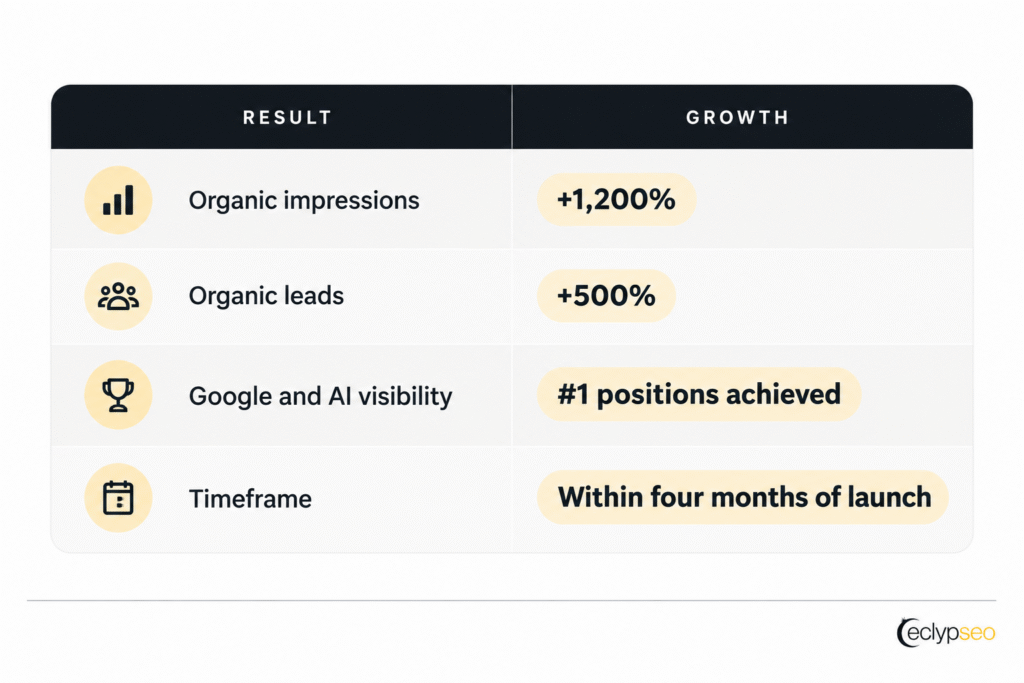
Four months later, the picture looked very different.
Organic impressions had increased by 1,200%.
Organic leads had increased by 500%.
The business had also reached number-one visibility across the Google and AI search environments tracked during the campaign.
The interesting part was not that we found a clever keyword.
We didn’t.
The growth came from building the signals a new service business normally lacks: trust, clear commercial positioning, useful expertise, stronger UX and a website structure that made the company easier for both customers and search systems to understand.
This is how we approached personal stylist SEO in Dubai without waiting years for the brand to establish itself naturally.
The results
The strongest result was not the increase in impressions. It was the increase in enquiries.
That distinction matters because impressions alone do not pay for an SEO campaign.
DapprDXB’s core online styling service currently carries a one-off fee of AED 1,199, meaning a qualified enquiry has obvious commercial value if it becomes a customer. The objective therefore was not simply to get more people onto the website. It was to increase visibility among people actively considering personal styling services in Dubai.
You can see the original project in our DapprDXB SEO case study.
The challenge: Google had no reason to trust a new brand
New websites start with a disadvantage that is easy to underestimate.
You know your company is legitimate.
Google does not.
Neither does a potential customer discovering you for the first time.
DapprDXB launched into a market containing established personal stylists, fashion businesses, publications and lifestyle brands that had already accumulated content, mentions, links and customer recognition.
The new site had none of that history.
This was particularly important because personal styling is a trust-led service.
A customer is not simply buying a commodity product. They are paying someone to assess their appearance, understand their preferences and make recommendations that may change how they dress professionally and personally.
Before someone submits an enquiry, they need to believe the stylist understands what they are doing.
Search engines face a version of the same problem.
Google’s people-first content guidance asks whether websites demonstrate first-hand expertise, whether it is clear who created the content and whether users would have reason to trust the information being provided.
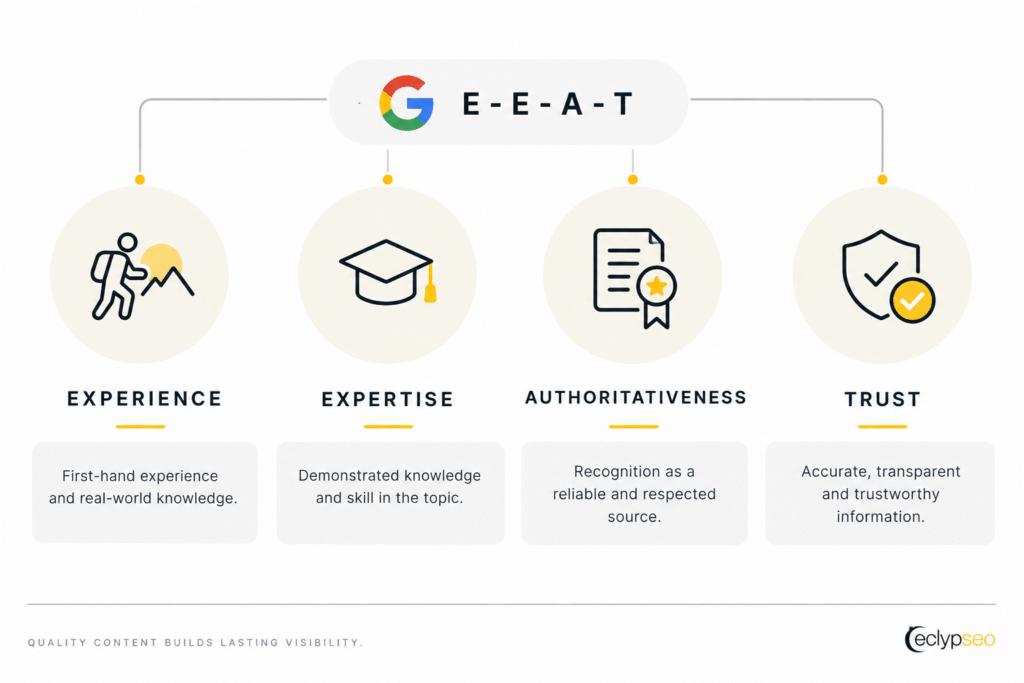
Google refers to these concepts through experience, expertise, authoritativeness and trust, commonly shortened to E-E-A-T. Google also makes clear that E-E-A-T itself is not one standalone ranking factor; rather, its systems use multiple signals associated with those qualities.
So our challenge was broader than ranking a page for personal stylist Dubai.
We needed to make a completely new business look and feel legitimate quickly, without manufacturing authority that did not exist.
1. We built the website around trust before traffic
The first mistake would have been treating the website as a container for keywords. For a new service business, the site itself has to do much more.
It needs to explain who the service is for, what happens after somebody enquires, what the customer receives and why they should trust the people providing it.
That shaped the architecture from the beginning.
The core pages were designed around clear service positioning rather than vague fashion copy. The customer journey explained how the personal assessment worked, how recommendations were created and what support continued afterwards.
The proposition was also made concrete.
Rather than asking a visitor to interpret what “personal styling” might mean, DapprDXB explains that customers receive personalised recommendations and a look book after an assessment of their preferences, body composition and lifestyle.
This is an important part of SEO for personal stylists because the conversion experience cannot be separated from rankings.
A visitor arriving through organic search still needs a reason to enquire.
Google can send the customer.
The website has to close the gap between interest and action.
2. We targeted commercial intent before chasing large search volumes
A new business can waste months producing informational traffic that has very little connection to its service.
That was not the priority here.
The initial focus was on searches where someone could realistically become a customer.
Terms around personal styling, online styling and men’s styling in Dubai have substantially greater commercial relevance to DapprDXB than a broad fashion keyword attracting people who simply want outfit inspiration.
That informed which core pages needed to become authoritative first.
The purpose was not to rank for the largest possible collection of keywords.
It was to build visibility where the customer journey was shortest.
This is the same principle behind Eclypseo’s wider content marketing approach: search volume is useful, but content should ultimately map back to intent, commercial value and the action the business wants the visitor to take.
For lead-generation companies, that usually means prioritising service demand before celebrating broad informational traffic.
3. We made experience and expertise visible
A personal stylist can genuinely understand colour matching, proportions, fabrics and wardrobe building. But Google cannot give credit to expertise that never appears on the website.
Neither can the customer.
So the strategy involved turning knowledge inside the business into visible evidence.

That meant clearer explanations around how recommendations were made, who the service was suitable for and how styling decisions differed depending on lifestyle, body type and budget.
The content also moved beyond generic fashion advice.
For example, DapprDXB has published detailed guidance around men’s clothing colours and skin tone, Dubai streetwear and sustainable fabrics. Those topics create useful opportunities to demonstrate knowledge connected directly to the service rather than publishing articles simply because a fashion keyword has volume.
This aligns closely with Google’s 2026 guidance for AI search.
Google now explicitly recommends creating unique, non-commodity content based on real knowledge, experience and original perspective rather than recycling information already available across the web. Its generative AI optimisation guide also says foundational SEO and genuinely useful content remain the basis for visibility in AI Overviews and AI Mode.
For DapprDXB, that meant the same work supporting both traditional rankings and AI search visibility.
4. We used thought leadership to strengthen the service
Blog content was still important.
But it had a job.
Instead of building an enormous publishing calendar around every fashion-related keyword we could find, thought leadership was used to demonstrate the expertise surrounding the commercial service.
That creates a much stronger relationship between informational and transactional content. Someone researching which colours suit their skin tone may not immediately purchase a styling service.
But that article can demonstrate the thinking behind professional styling, introduce the brand and help establish DapprDXB as a knowledgeable source within the wider subject.
Relevant articles can then connect naturally towards commercial pages when the reader needs personalised support rather than general advice.
For a new business, that relationship is considerably more useful than publishing twenty unrelated articles and hoping traffic eventually turns into leads.
5. We treated UX as part of SEO
SEO campaigns often stop at the search result.
We do not think that is enough.
If a site ranks but the user lands on a confusing page, the acquisition work has only solved half the problem. DapprDXB therefore needed a user experience that made the service easy to understand quickly.
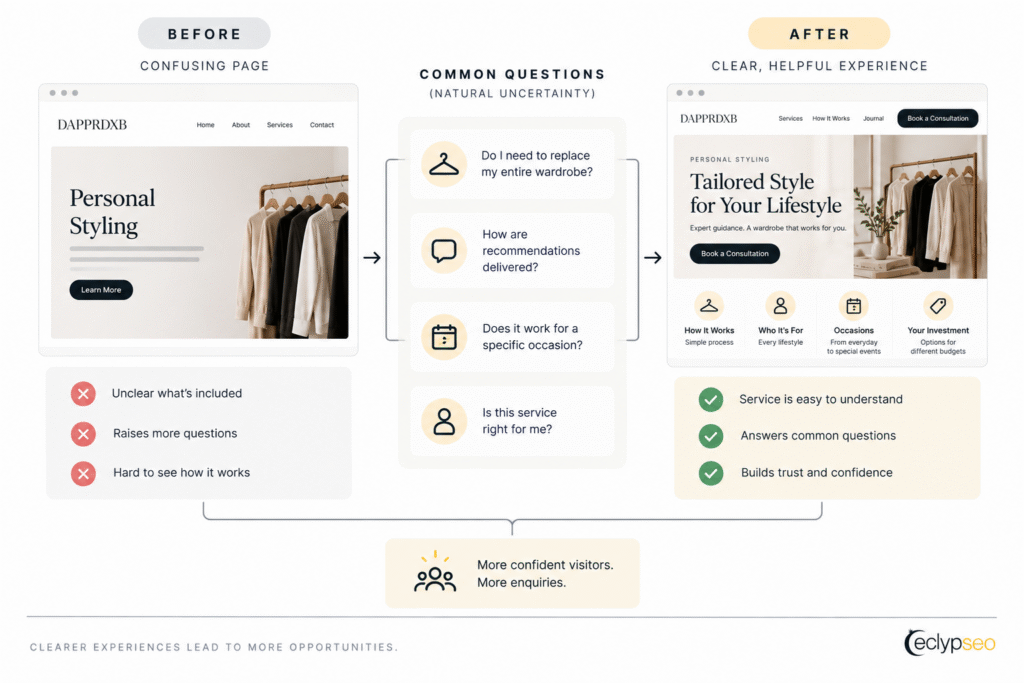
The business also needed to overcome the natural uncertainty surrounding an unfamiliar service. Customers may wonder whether styling requires replacing their entire wardrobe, how recommendations are delivered or whether the service works for a specific occasion.
Answering those objections helps conversion. It also produces a more complete page.
Google’s people-first guidance explicitly encourages websites to provide an overall satisfying page experience alongside useful content. That does not mean UX is reduced to one ranking metric. It means strong organic acquisition performs better commercially when the landing experience actually helps the visitor complete their task.
The result was an SEO campaign measured through organic lead generation.
6. We built the brand for Google and AI search at the same time
One of the more interesting outcomes was DapprDXB’s visibility beyond traditional Google results. The project reached top visibility across major AI platforms tracked during the campaign.
We did not create a separate “AI website” to achieve that.
There was no secret AI schema or special file capable of forcing ChatGPT or Google AI to recommend the company.
The same underlying work mattered: strong service clarity, visible expertise, structured information, useful supporting content and clearer trust signals.
Google’s current guidance says exactly this.
There are no special technical requirements for appearing as a supporting link in AI Overviews or AI Mode beyond being indexed and eligible for normal Google Search. Google also specifically advises site owners to focus on foundational SEO and valuable content rather than chasing GEO hacks. (developers.google.com)
Eclypseo’s AI and GEO optimisation uses that same model.
SEO establishes the technical and search foundation.
GEO extends the work by making a company’s expertise, entities and evidence easier for AI systems to understand and reference.
DapprDXB was particularly suitable for that approach because the business occupied a clearly defined niche: Dubai-based men’s personal styling.
Clear positioning makes a brand easier to understand than a company attempting to associate itself with dozens of unrelated services.
7. We kept the Dubai context commercially relevant
Being based in Dubai mattered.
Stuffing “Dubai” into every heading would not have helped.
The better approach was making the location part of the actual service context.
DapprDXB operates from Jumeirah Lake Towers and serves Dubai-based men through an online styling model. Its content can also address questions affected genuinely by the local environment, including climate, fashion culture and the lifestyles of customers living in the UAE.
That gives location relevance..
It also supports wider local SEO in Dubai without manufacturing dozens of weak pages for every neighbourhood.
For businesses where local discovery is important, Google Business Profile, consistent business information, reviews and genuine local references can reinforce those signals further.
Our local SEO service follows the same principle that location optimisation should strengthen real customer discovery rather than produce artificial pages built around place names.
Why did the strategy work so quickly?
There was no single reason.
That is probably the most useful part of the case study.
DapprDXB did not grow because we found one low-competition keyword. The brand did not suddenly become visible because schema was installed.
And AI platforms did not start recognising the company because we created an llms.txt file.
Several signals strengthened together. The service became easier to understand.
And the business gave search engines more evidence that it represented a legitimate entity within a clearly defined niche. For a brand starting from almost zero, building all of those foundations together was faster than spending months trying to manufacture authority around weak pages.
What we would not take from this case study
A 500% increase sounds impressive.
It also needs context.
DapprDXB started as a new business, which means the initial organic baseline was low. Percentage growth naturally looks larger when the starting point is small.
That does not make the result meaningless.
Generating five times more organic leads within four months is commercially useful for a new lead-generation business, particularly when visibility is being built from scratch.
But we would not use this case study to promise every company a 500% increase.
An established brand starting with thousands of monthly organic enquiries operates from a completely different baseline.
Competitive environment, demand, website history, technical health, authority and conversion rates all affect what is achievable.
The lesson is really all about strategy..
What other Dubai service businesses can learn from DapprDXB
The biggest takeaway is that a new website does not need to wait passively for authority to appear. You can deliberately build trust.
Make the service easier to understand than competitors. Show real expertise instead of claiming it.
And make sure Google and AI systems encounter consistent information about who you are, what you do and where you operate.
This applies beyond personal styling.
Consultants, interior designers, clinics, coaches, professional services and other expertise-led businesses face the same fundamental problem when they launch.
Starting from zero does not mean your SEO has to stay there
DapprDXB went from having no meaningful search footprint to generating 500% more organic leads and 1,200% more organic impressions, while building top visibility across Google and AI search within four months.
The work focused on the parts of SEO that mattered commercially: service intent, trust, expertise, user experience and clear positioning.
If your business has recently launched in Dubai, or you have a strong service but organic search still produces very few qualified enquiries, Eclypseo can identify whether the gap sits in your positioning, website, content, local visibility or wider authority.
Speak with a senior SEO consultant in Dubai or book a free SEO strategy consultation to understand where organic search can realistically contribute to leads and revenue.