
A sudden fall in organic traffic can make it feel as though Google has switched your website off overnight.
That was the situation facing RoxHype, a fitness brand and AI-powered HYROX training platform offering personalised workouts, training plans, race guidance and performance content for athletes.
The website had built strong organic visibility across valuable HYROX searches.
Then, following Google’s December 2025 core update, performance dropped sharply across the site.
This was not one article losing a few positions.
RoxHype’s strongest pages, FAQs and high-intent queries all moved in the wrong direction. Organic traffic fell by more than 40%, while some previously competitive pages slipped well beyond page one.
We needed to identify why the decline happened, separate technical problems from content problems, and build an SEO recovery strategy without damaging what had worked before.
Within six weeks, daily organic impressions increased by 100%. Engagement and dwell time improved by 25%, and the issues behind the original decline had been diagnosed and addressed. Eclypseo’s published results confirm the doubling of impressions and six-week recovery period.
The Results at a Glance
RoxHype achieved:
- A 100% increase in daily organic impressions
- A 25% increase in engagement and dwell time
- A six-week recovery period
- A 40%+ organic decline diagnosed and addressed
The numbers matter. But the more useful part of this Google algorithm update recovery is understanding what caused the decline and why the changes worked.
The Drop Was Not a Penalty
RoxHype’s visibility fell on 11 December 2025.
That date mattered because Google’s December 2025 core update began rolling out on the same day. The rollout continued until 29 December.
Core updates are broad changes to how Google assesses and ranks content. They are not designed to punish one website. Google describes them as changes intended to surface more helpful and reliable results across Search.
That meant we could not assume RoxHype had been penalised simply because the timing matched.
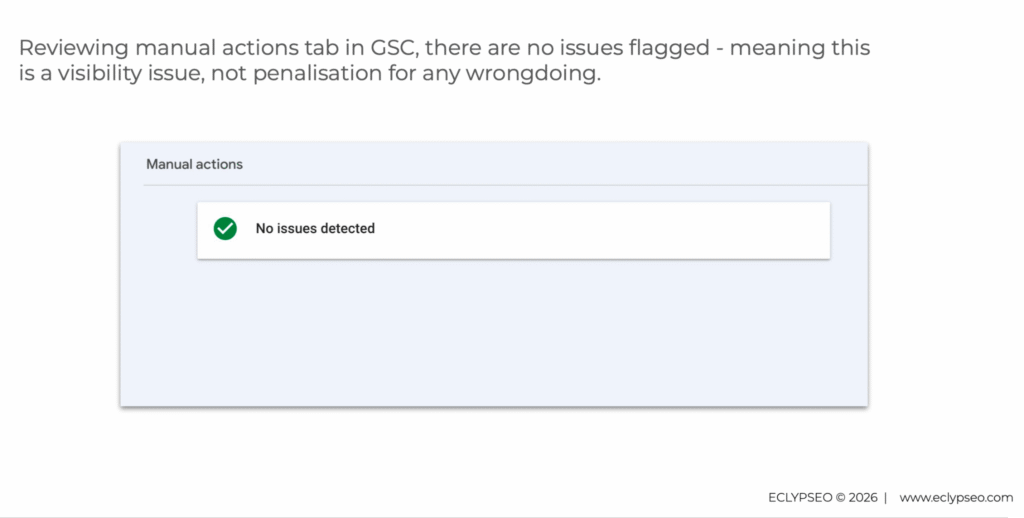
The first step in the technical SEO audit was to check Google Search Console for manual actions. None were present. The website had not been issued a manual penalty.
This changed the recovery approach.
RoxHype instead had a competitiveness problem. Google had reassessed the search landscape, and other pages were now being judged as stronger answers for queries the site had previously performed well for.
The question was no longer, “What rule did the website break?”
It was, “Why have these pages become less competitive?”
The Decline Was Sitewide, Not Isolated
The audit compared performance before and after the update using Google Search Console and GA4.
The pattern was consistent.
Important HYROX queries lost clicks and impressions. High-performing articles and FAQ pages also declined. The impact was particularly visible across major markets such as the UK and US, where some pages moved from an average position around five to much weaker positions across pages two to five.
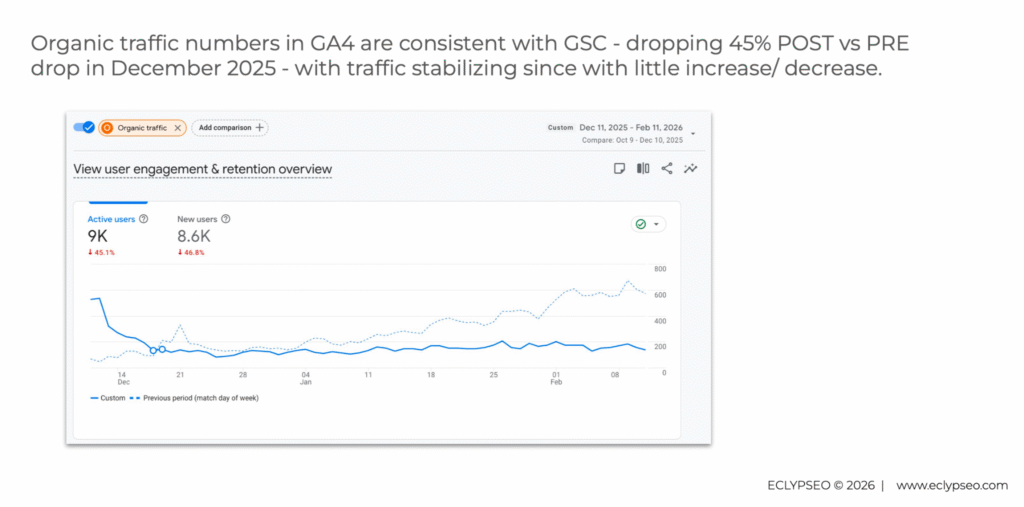
GA4 supported what Search Console was showing.
Organic traffic was approximately 45% lower in the post-update period than in the period before the decline.
That distinction was important.
When many unrelated pages decline together, the investigation has to look at the website as a whole. For RoxHype, the loss of organic visibility pointed to sitewide quality, trust, crawlability and engagement problems.
Indexation Was Quietly Limiting the Site
The next major issue was indexation.
At the time of the audit, around 75% of the website was not indexed by Google. A large group of workout URLs had been crawled but not indexed, while duplicate URLs, redirects and canonical signals created additional noise.
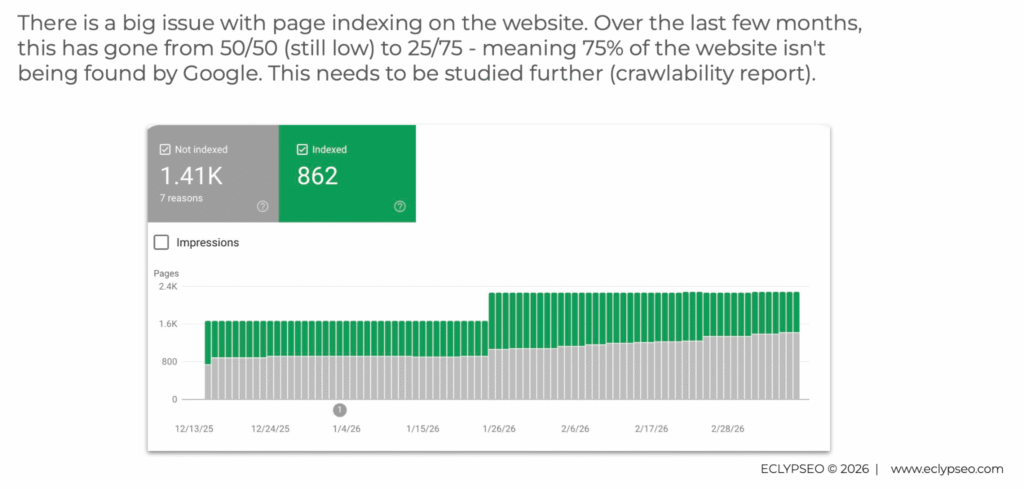
Not every excluded page needed to rank. Some low-value or duplicate pages should not appear in Google at all.
The problem was that the website was giving Google too many URLs to assess without making its priority pages clear enough.
Website indexation issues are more than a dashboard warning. When priority pages are buried among duplicate or poorly differentiated URLs, search engines receive weaker signals about which content deserves attention.
Our work focused on prioritisation, not forcing every URL into the index.
We reviewed crawled-but-not-indexed pages, consolidated low-value content, clarified technical signals and made important pages easier to discover.
The aim was to create a cleaner relationship between the site’s best articles, training resources and app journeys.
Our guide to indexation and crawl budget explains why Google may ignore a page even after crawling it, and why better internal priorities matter more than simply submitting URLs again.
Long Content Was Not Automatically Useful Content
RoxHype already had substantial articles. Some exceeded 3,000 words.
But length alone was not producing a strong user experience.
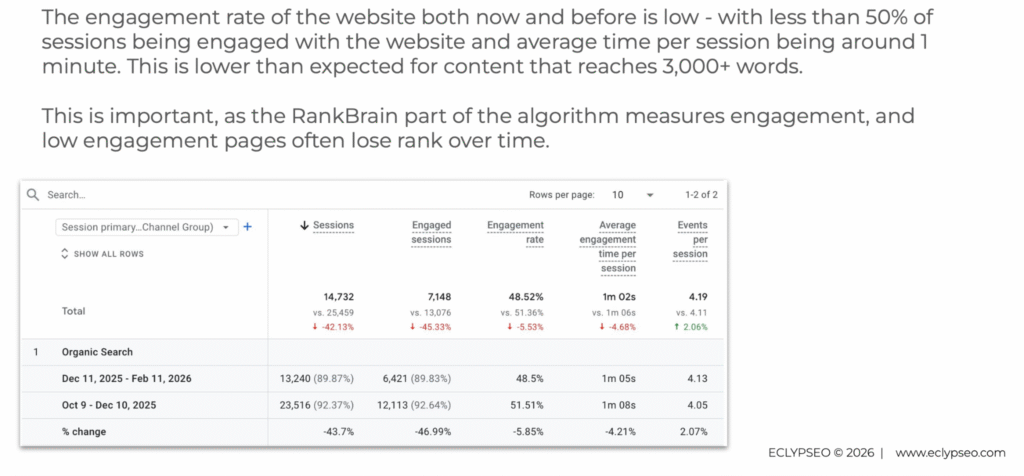
Engagement was below 50%, and average engagement time was around one minute. For pages designed to answer detailed training and performance questions, that suggested readers were not finding information quickly enough or were not being given a clear reason to continue.
Google does not publish a preferred word count. Its people-first content guidance instead asks whether a page provides original information, useful analysis, visible expertise and a satisfying experience.
That aligned closely with what the audit found.
Some pages contained useful benchmark information but did not explain the methodology behind it. Others answered the general query without providing enough athlete examples, expert commentary, race experience or practical interpretation.
The articles did not need extra paragraphs for the sake of length.
They needed stronger content quality.
We Rebuilt Priority Pages Around Search Intent
The first content action was to identify the pages that had lost the most organic visibility and still had the strongest potential to recover.
We did not rewrite everything at once.
Priority went to articles that had previously generated meaningful organic impressions, ranked for valuable HYROX searches and continued to show demand in Search Console.
Each page was reviewed against the queries it appeared for.
We checked whether each opening answered the search quickly, whether headings matched the athlete’s needs, and whether the advice offered enough depth, evidence and explanation to earn trust.
This created a practical content refresh strategy.
Sections were rewritten, repetitive copy was removed, important answers moved closer to the top, and tables or structured sections were used where they made comparison easier.
It followed the same principle covered in our guide to refreshing old content: use performance data to decide what to update, then make meaningful improvements rather than changing the date and calling the page fresh.
We also used Search Console query data to identify unanswered questions and pages that were still receiving impressions without winning enough clicks. Our Google Search Console regex guide explains how question, commercial and long-tail queries can be isolated and turned into practical content actions.
We Strengthened Experience, Expertise and Trust
Fitness content carries a higher trust requirement than a generic lifestyle article.
Training guidance can influence how someone prepares and exercises. Even accurate information is harder to trust when the source is unclear.
RoxHype’s existing content often presents information without making the expertise behind it visible.
The audit identified opportunities to add clearer author information, first-hand race and training experience, athlete examples, performance breakdowns, dataset explanations, benchmark methodology and transparent sourcing.
These changes strengthened the site’s E-E-A-T signals: experience, expertise, authoritativeness and trustworthiness.
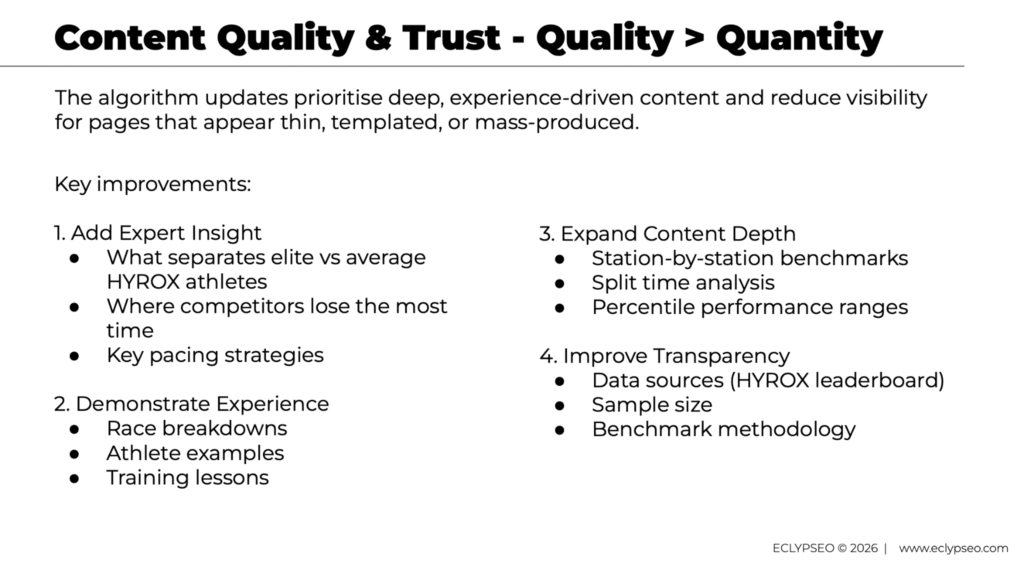
E-E-A-T is not one direct ranking factor that can be switched on. Google uses it as a framework for assessing whether search results demonstrate the qualities people would associate with trustworthy content, with trust being the central consideration.
For RoxHype, this meant turning anonymous-looking information into content that felt owned, explained and supported by people who understood the sport.
The work also supported a stronger content marketing model. Instead of producing more articles simply to target more keywords, the focus shifted towards useful topic depth, buying intent and original expertise.
We Improved Internal Linking and Topic Structure
RoxHype had already built useful topical depth around HYROX.
But the connections between pages were not always strong enough.
An athlete reading about average race times might also need pacing advice, station benchmarks, training plans or a workout relevant to their weakest movement. Those journeys should not end with the article they landed on.
We developed a clearer internal linking strategy between priority guides, FAQs, workout pages and app-related resources.
This gave users a logical next step and helped search engines understand the relationship between topics and the priority pages within each cluster.
Internal links were added contextually. Anchor text described the destination clearly, and stronger pages supported priority URLs that had lost visibility.
Fixing crawlability without improving page relationships would only have solved part of the problem. Eclypseo’s technical SEO approach treats internal linking as both a crawl path and a way to reinforce page relevance.
We Made Engagement a Measurable Goal
The recovery was not judged on organic impressions alone.
Better rankings are useful, but they do not show whether the visitor found the page helpful or took a meaningful action.
We improved scanability, tightened introductions, clarified navigation between related topics and made calls to action more relevant to each page.
We also improved the measurement plan.
The original GA4 setup did not provide enough visibility into actions such as tool usage, app interaction and downloads. Better event tracking made it possible to separate passive visits from users who engaged with the product.
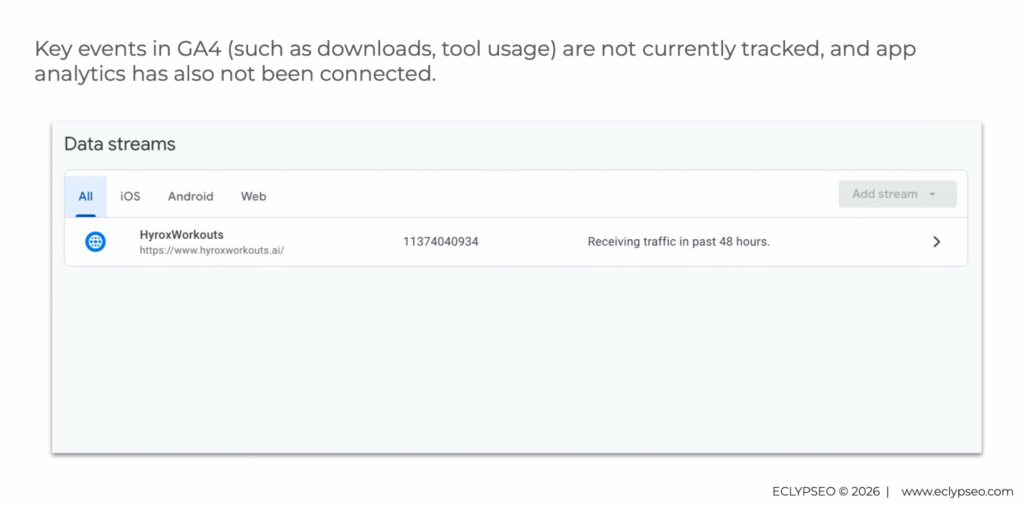
This is where conversion rate optimisation supports SEO.
The goal was not to add aggressive banners. It was to make the next useful action obvious, whether that meant exploring a training plan, trying a tool or moving towards the app.
Conversion rate optimisation follows the same principle: analyse actual behaviour, remove friction and test changes against meaningful actions rather than assumptions.
Why Organic Impressions Doubled
There was no single switch that doubled performance.
The increase came from several improvements reinforcing each other.
Higher-quality pages gave users clearer answers. Stronger author, methodology and sourcing information improved trust. Cleaner indexation helped Google focus on better URLs. Improved internal linking strengthened the relationship between priority topics. Better formatting supported engagement. More complete tracking showed whether returning traffic also produced meaningful behaviour.
Within six weeks, RoxHype’s daily organic impressions increased by 100%, while engagement and dwell time rose by 25%.
That does not mean every website affected by a core update will recover on the same timeline. Google’s guidance on core updates states that some improvements may be reflected within days, while broader reassessment can take several months.
It does show why a structured Google algorithm update recovery plan is more effective than reacting with random edits.
What Other Fitness Brands Can Learn From the Recovery
The biggest lesson is not to assume that a sudden decline is a penalty.
Start with evidence.
Compare the timing with confirmed updates. Check manual actions. Review pages and queries before and after the decline. Separate ranking losses from website indexation issues. Then assess whether the content still provides a competitive answer.
For brands investing in fitness SEO in Dubai, the same fundamentals apply even when the audience is international.
A fitness website needs technically accessible pages, clear topic structure, original expertise, transparent sources and useful next steps. Publishing more articles will not solve weak quality signals if existing content is difficult to trust, navigate or index.
A good SEO recovery strategy protects what already works and improves the areas that changed the competitive balance.
That is what happened with RoxHype.
The website did not need to start from zero. It needed a clearer technical foundation, more useful content, stronger trust signals and a better connection between visibility and engagement.
Been Hit by a Google Update? Do Not Guess What Changed
A traffic drop rarely explains itself.
Search Console can show where clicks and organic impressions were lost, but it will not hand you a complete recovery plan. The answer often sits across content quality, indexation, technical structure, trust and user behaviour.
Our technical SEO and content marketing teams investigate those signals together, then prioritise the work most likely to restore organic visibility and commercial value.
Explore more client outcomes on our results page. Or, if your website has experienced a sudden decline, contact Eclypseo to book a strategy call and find out what is holding the recovery back.